
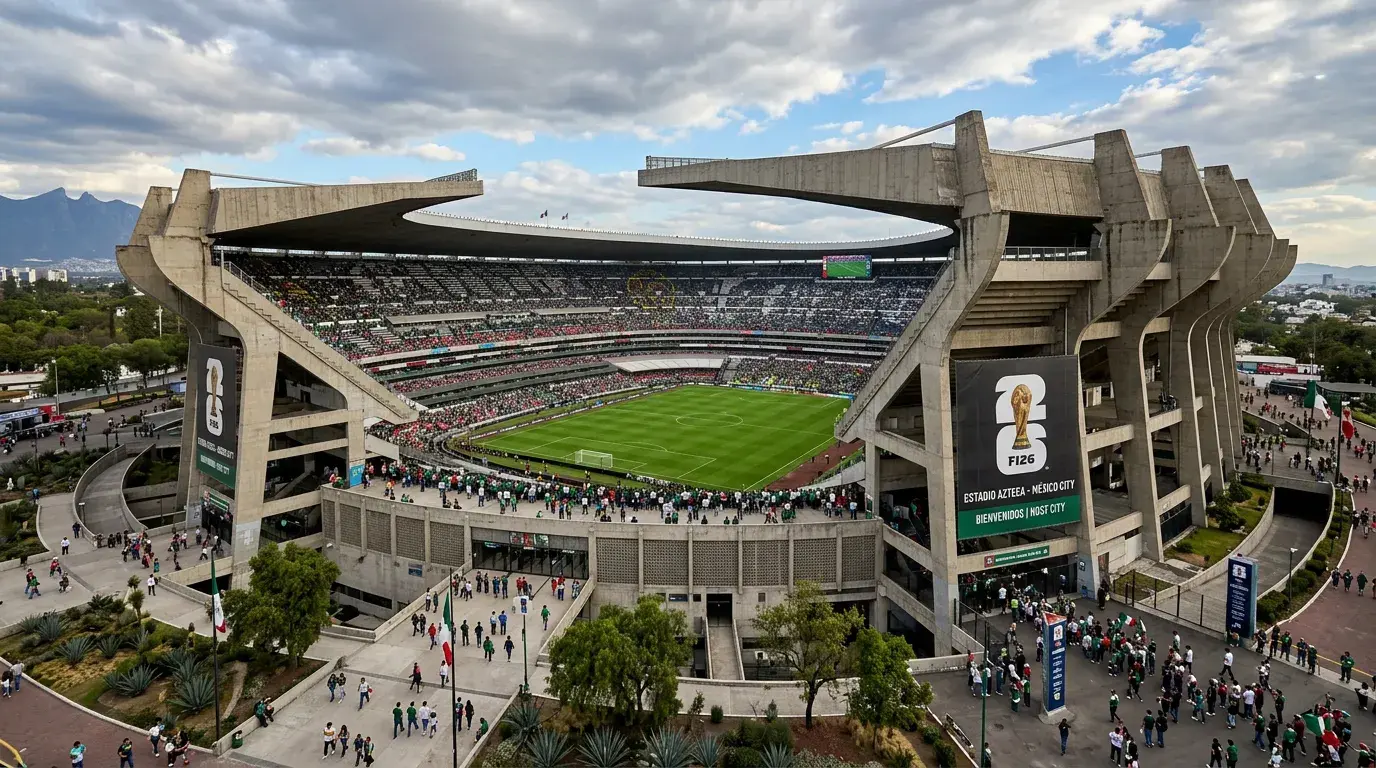
On 11 June 2026, Estadio Azteca will host the opening match of FIFA World Cup 2026 — Mexico versus South Africa in a fixture that launches football’s grandest tournament. This iconic venue becomes the first stadium in history to host three World Cups, adding 2026 to the 1970 and 1986 tournaments that established the Azteca as sacred ground for football’s global community. For Australian punters, the opening match provides the first betting opportunity of a tournament that will consume attention for the following thirty-nine days.
Estadio Azteca’s selection for the opening fixture honours Mexican football culture that has made this venue legendary beyond its architectural significance. The stadium has witnessed moments that define World Cup history — Diego Maradona’s “Hand of God” and “Goal of the Century” against England in 1986, Pelé’s 1970 Brazilian triumph, and countless other memories that subsequent generations experience only through footage. The 2026 opening match adds contemporary chapter to this unparalleled heritage.
Stadium History and Legendary Status
Estadio Azteca opened in 1966 as the largest stadium in the Americas, constructed specifically to host the 1970 World Cup that Mexico had won the right to organise. The approximately 87,000 capacity (reduced for modern safety standards) established the venue as continental football’s cathedral, with architecture that influenced stadium design for decades afterward. The distinctive concrete cantilever roof and bowl-shaped seating created sightlines that placed spectators close to the action despite massive overall capacity.
The 1970 World Cup final at Estadio Azteca produced one of football’s most celebrated matches — Brazil’s 4-1 victory over Italy featuring goals from Pelé, Gérson, Jairzinho, and Carlos Alberto. That final established Brazil as football’s reference point and the Azteca as worthy stage for such historic occasions. The stadium’s altitude (2,240 metres above sea level) added physical dimension that influenced match dynamics and tactical approaches throughout the tournament.
Mexico’s 1986 World Cup returned major tournament football to Estadio Azteca, producing moments that transcend sporting significance. Diego Maradona’s quarter-final performance against England — the controversial handball followed minutes later by slaloming individual brilliance — created football mythology that defines the sport’s narrative possibilities. These events occurred within the Azteca’s walls, making the stadium itself a character in football history rather than merely the venue where history happened.
The decades since 1986 have seen Estadio Azteca host countless significant matches including CONCACAF Champions League finals, FIFA Club World Cup fixtures, and international friendlies that maintain the venue’s prestige. Regular renovation has updated facilities while preserving the architectural identity that makes the Azteca immediately recognisable. The 2026 World Cup represents culmination of continuous improvement preparing the stadium for its third tournament hosting.
Opening Match: Mexico vs South Africa
The opening match pairing of Mexico versus South Africa creates compelling narrative that honours both the tournament’s expansion and African football’s growing significance within FIFA’s global structure. Mexico carries host-nation expectations before passionate home support that will generate atmospheric intensity unmatched elsewhere in the tournament throughout all thirty-nine days. South Africa brings memories of their own 2010 hosting while seeking competitive validation that mere group-stage presence alone cannot provide for a proud football nation.
Kick-off timing for the opening match falls at 7:00 AM AEST on Thursday 12 June — early morning viewing that dedicated Australian punters will accommodate despite the challenging hour requiring alarm settings. This timing reflects American prime-time broadcasting priorities (evening local time in Mexico), with international audiences adjusting schedules accordingly to participate in tournament’s launch. The opening match establishes tournament rhythms that subsequent fixtures follow throughout the competition, making early engagement worthwhile for those seeking comprehensive World Cup immersion from the first whistle.
Mexico enters as significant favourites with home-ground advantage supplementing squad quality that CONCACAF qualification consistently demonstrated. The emotional weight of opening a third home World Cup creates pressure that could inspire transcendent performance worthy of the occasion or generate anxiety that disrupts execution when precision matters most. Historical precedent offers mixed guidance — host nations typically perform well in opening fixtures, though expectation burden sometimes produces underwhelming results that require subsequent recovery.
South Africa’s competitive prospects depend significantly on whether their squad can manage altitude challenges that Estadio Azteca’s Mexico City location creates for unfamiliar visitors. Teams unaccustomed to high-altitude football face physiological challenges that affect endurance, recovery between efforts, and tactical intensity sustainability over ninety demanding minutes. South African preparation will emphasise altitude acclimatisation that tournament scheduling might not permit adequately given travel logistics.
The opening match’s symbolic significance exceeds its competitive importance for Australian interests despite the compelling theatre it provides. Group A results affect Socceroos only indirectly through knockout-round bracket implications that remain speculative during group stages when Australian matches occupy primary attention. Australian punters approach the opening fixture as tournament appetiser rather than consequential betting opportunity — establishing form assessment frameworks that subsequent matches refine as patterns emerge.
Technical Specifications and Altitude Factor
Estadio Azteca’s World Cup 2026 capacity will be approximately 81,000 — reduced from historical maximums through safety regulations that modern tournaments require. This capacity places the venue among the tournament’s largest while maintaining the atmospheric intimacy that the stadium’s design provides. Bowl-shaped seating surrounds the pitch entirely, creating acoustic environment where 81,000 voices combine into overwhelming sound.
The playing surface at Estadio Azteca uses natural grass that Mexico City’s climate supports with careful maintenance throughout the year. The stadium’s open-air design exposes the pitch to sun and rain that influence surface conditions, though groundskeeping expertise ensures consistent quality for major fixtures. Both teams will train on similar surfaces during preparation, eliminating surface adaptation as significant competitive factor.
Altitude represents Estadio Azteca’s most distinctive characteristic affecting match dynamics and betting considerations. At 2,240 metres above sea level, air pressure reduction affects ball flight, player endurance, and recovery rates in ways that sea-level venues cannot replicate. Teams accustomed to altitude (Mexico, some South American nations) gain advantages that visiting sides must counteract through preparation and tactical adjustment.
Ball flight at altitude produces longer distances and different trajectories than sea-level conditions create. Long passes travel further before dropping, while shots generate more movement through the air. Goalkeepers must adjust positioning and timing, while outfield players recalibrate passing distances. These adjustments require experience that unfamiliar teams develop only through extended altitude exposure.
Player endurance suffers at altitude as reduced oxygen availability increases fatigue accumulation rates. High-intensity pressing becomes unsustainable over ninety minutes, favouring teams who manage tempo rather than maintaining continuous pressure. Substitution strategy gains importance as fresh legs replace fatigued players whose altitude-affected recovery cannot sustain performance levels.
Location and Mexico City Context
Estadio Azteca occupies a site in southern Mexico City within the Coyoacán borough, accessible via multiple transport options that the city’s extensive infrastructure provides. The stadium sits alongside the historic Azteca television complex, creating a media hub that supports World Cup broadcasting requirements. Mexico City’s massive population (over 21 million in the metropolitan area) ensures supporter availability regardless of competing attraction elsewhere.
Mexico City’s international airport provides global connectivity that positions the capital as accessible destination for international visitors despite geographical distance from Australian departure points. The approximately 20-hour journey from Sydney or Melbourne requires commitment that dedicated supporters will make for World Cup tournament attendance at football’s most legendary venue. Accommodation options throughout Mexico City range from luxury to budget alternatives, with Coyoacán offering local options near the stadium that reduce match-day transport complexity.
Security considerations for Mexico City travel require acknowledgment without exaggeration that might discourage legitimate tourism. The metropolitan area includes varying safety profiles across different neighbourhoods, with tourist areas and major sporting venues generally well-protected by established security presence. Tournament-specific security measures will enhance existing infrastructure for World Cup fixtures, creating controlled environments that international visitors can navigate with reasonable precaution and awareness.
Betting Considerations for the Opening Match
Home-ground advantage at Estadio Azteca represents the primary betting consideration for Mexico versus South Africa in the tournament’s opening fixture. The combination of passionate support from 81,000 Mexican fans, altitude familiarity developed through domestic football, and tournament-opening pressure creates conditions where Mexico should dominate proceedings regardless of South African defensive organisation. Mexico at approximately $1.40 reflects overwhelming favouritism that the fixture’s dynamics comprehensively justify.
Altitude impact on South African performance suggests goals might flow as the match progresses and fatigue accumulates for the unfamiliar visiting team. Over 2.5 goals at approximately $1.70 offers value if you believe Mexico’s attacking quality will exploit defensive lapses that altitude-induced fatigue creates in the match’s later stages as legs tire. First-half under 1.5 goals combined with second-half goals provides structure for those expecting slow start before altitude effects manifest more prominently.
Opening match dynamics historically produce cautious football as teams avoid early tournament embarrassment that would damage confidence for subsequent fixtures. Draw at half-time represents common pattern where teams assess opponents before committing to attacking approaches that carry risk. Mexico to lead at half-time at approximately $1.75 remains the likely outcome, but draw at half-time at approximately $3.00 offers value for those expecting opening-match caution regardless of eventual final result.
Correct score markets provide opportunities for precise prediction that the fixture’s likely dominance creates. Mexico 2-0 at approximately $6.00 captures controlled victory that avoids unnecessary risk while demonstrating quality. Mexico 3-1 at approximately $9.00 offers higher returns if South Africa manages one goal before Mexican superiority proves decisive in the final outcome.
The opening match establishes tournament-wide patterns that subsequent betting incorporates into analysis. Mexican performance reveals whether home-tournament pressure inspires or burdens the squad for remaining group fixtures. South African competitiveness indicates African confederation quality that informs assessment of other African nations throughout the tournament. These insights justify opening-match engagement beyond the fixture’s immediate betting opportunities, creating analytical foundation for the tournament’s remaining matches across all twelve groups. For comprehensive tournament strategies, see our complete World Cup 2026 betting guide.