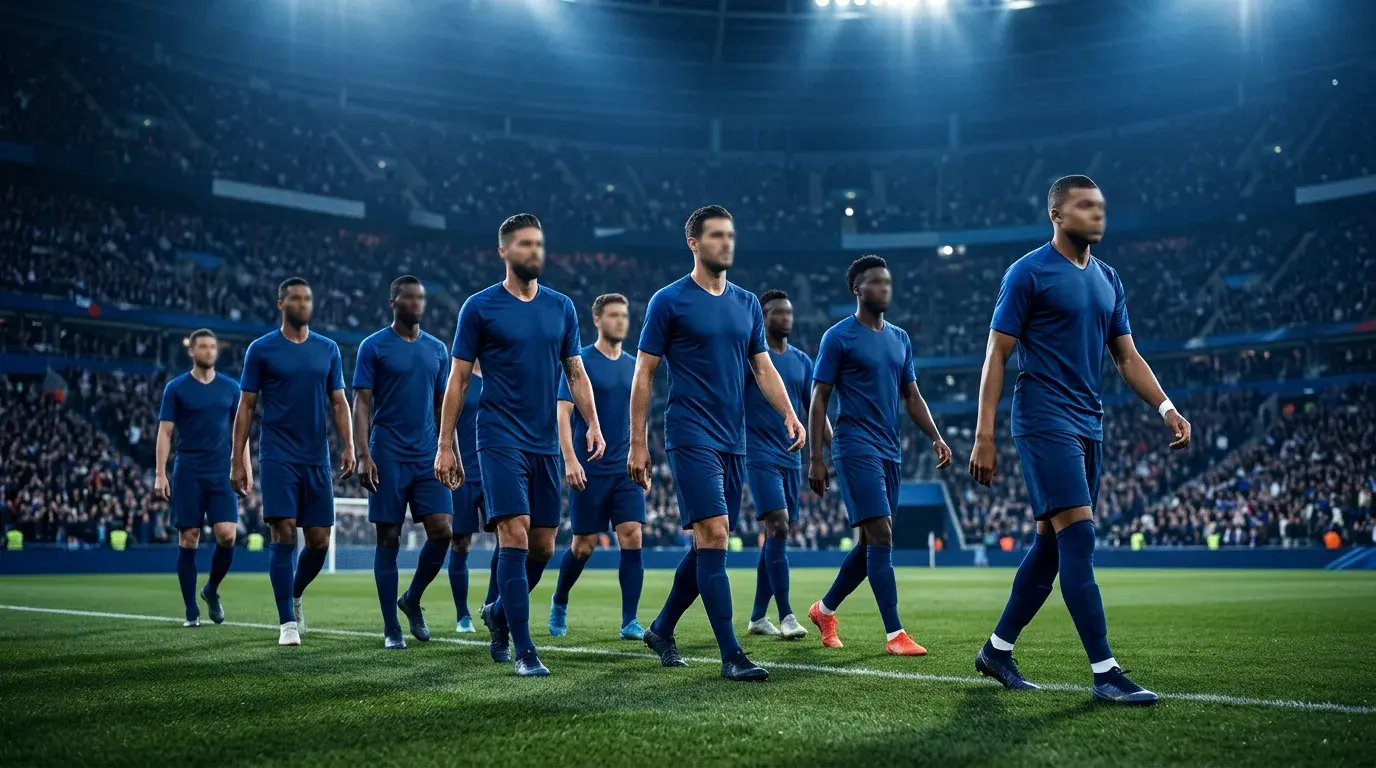
The image that lingers from Qatar 2022: Kylian Mbappé standing alone at the centre circle, hat-trick complete, watching Argentina celebrate the penalty shootout victory that denied France back-to-back titles. That moment — the greatest individual World Cup final performance in defeat — encapsulates everything about France World Cup 2026. Les Bleus possess a generational talent in Mbappé whose individual brilliance can decide matches, yet tournament success requires collective excellence that France has sometimes struggled to produce.
Didier Deschamps approaches what may be his final tournament as manager with a squad that blends 2018 champions with emerging talents demanding their moment. The French conveyor belt of elite players shows no signs of slowing — Ligue 1 academies continue producing talents that Europe’s biggest clubs acquire for record fees. This depth creates selection dilemmas that most managers would envy, yet also generates dressing room dynamics that have historically complicated French tournament campaigns.
For Australian punters assessing the France World Cup 2026 odds, the betting markets reflect this duality. Les Bleus trade among the top three or four favourites, with pricing that acknowledges both the squad’s quality and the uncertainty that French teams generate. Understanding where value exists requires parsing individual brilliance from collective reliability — a balance that defines French football’s modern identity.
Mbappé’s Mission to Match Pelé’s Legacy
Kylian Mbappé enters World Cup 2026 chasing historical achievement that only Pelé has accomplished — winning two World Cups as the tournament’s defining player. His 2018 triumph arrived as a teenage sensation whose pace terrorised Argentina’s defence. His 2022 final hat-trick demonstrated that individual genius can nearly overcome collective shortcomings. Now, at 27, Mbappé arrives at optimal maturity — physical peak combined with tournament experience that cannot be purchased.
The Real Madrid move that dominated pre-tournament narratives has positioned Mbappé among football’s elite environments. Competing alongside Vinícius Jr and within an institution that demands Champions League success has added dimensions to his game. The positional discipline that Los Blancos require has developed tactical understanding beyond raw athleticism. Whether this translates to international football, where team structures differ from club routines, determines France’s ceiling.
Mbappé’s tournament statistics across two World Cups establish him among history’s great performers. Twelve goals in 14 World Cup matches places him alongside Ronaldo, Müller, and Pelé in all-time rankings. His combination of pace, finishing, and big-game mentality creates fear among defenders that extends beyond any statistical measurement. When France needs a decisive moment, Mbappé’s presence means that moment remains possible regardless of match context.
The burden of expectation accompanies this brilliance. France’s tournament success increasingly depends on Mbappé’s individual production — when he underperforms, the team struggles to generate alternative attacking solutions. This dependency creates vulnerability that opponents target through defensive attention that limits his space and time. Finding teammates who can share creative burden becomes essential for 2026 progression.
Captaincy responsibilities add leadership dimension that previous tournaments lacked. Hugo Lloris’s retirement transferred armband to Mbappé, whose public profile and commercial presence makes him France’s most visible sporting figure. Managing this pressure while maintaining individual performance requires maturity that few players possess. The weight of an entire nation’s expectations — 67 million people anticipating sixth-star success — shapes tournament psychology in ways that club football never replicates.
Analysing Les Bleus’ Squad Composition
French squad depth at World Cup 2026 creates selection debates that would paralyse most national team managers. Every position features multiple elite-level options, producing internal competition that maintains standards while potentially generating friction. Deschamps’ management of egos has defined his tenure — his ability to maintain harmony determines whether talent translates to trophies. The 2010 World Cup mutiny serves as eternal reminder of how talented French squads can self-destruct when collective cohesion breaks down.
Goalkeeping presents the clearest selection with Mike Maignan establishing himself as France’s undisputed number one following Lloris’s international retirement. His AC Milan performances have demonstrated shot-stopping quality matching any goalkeeper in world football, while his distribution adds to France’s build-up options. The transition from Lloris’s decade-long stewardship has proven seamless, providing stability that some positions lack. Maignan’s command of his area and communication with defenders has developed rapidly, creating defensive organisation that supports attacking ambition.
The defensive structure combines experience with emerging quality. William Saliba’s Arsenal development has created a centre-back comfortable building from the back while maintaining defensive solidity. His reading of the game exceeds expectations for his age, positioning himself to intercept danger before it materialises. His partnership options include Dayot Upamecano’s athleticism, Ibrahima Konaté’s aerial dominance, and various alternatives whose rotation keeps competition intense. Full-back selections generate more debate — Theo Hernández’s attacking instincts from left-back create opportunities while exposing spaces that quick opponents exploit. His brother Lucas provides alternative with more defensive discipline but less offensive threat.
Central midfield defines France’s control capabilities. Aurélien Tchouaméni has emerged as the defensive anchor, providing screening cover that allows more creative players freedom. His development at Real Madrid has accelerated beyond initial projections, adding offensive contributions to his defensive foundations. The passing range he demonstrates opens transitions that quick forwards exploit. Alongside him, N’Golo Kanté’s tournament experience remains valuable despite aging legs, while Eduardo Camavinga offers youthful energy that can change match dynamics through introduction. The depth in this position exceeds most competitors.
The attacking options beyond Mbappé feature embarrassing riches. Ousmane Dembélé’s pace on the opposite wing creates symmetrical threat that defences cannot simply load toward Mbappé’s side. His final product has improved dramatically since his inconsistent Barcelona years. Antoine Griezmann’s positional intelligence between the lines generates creative combinations that unlock organised defences. Randal Kolo Muani’s emergence as penalty-box threat provides alternatives when possession dominance fails. Marcus Thuram’s aerial ability adds different dimensions. This depth allows tactical variation that opponents struggle to prepare for across tournament progression.
The striker position has evolved since Olivier Giroud’s retirement from international football. No direct replacement possesses his hold-up ability, forcing France toward more mobile forward configurations. This tactical shift suits Mbappé’s central movement but removes the target man option that previous tournaments utilised effectively. Whether France adapts successfully determines knockout round outcomes against defensively organised opponents who deny space for Mbappé’s runs behind defences.
Deschamps’ Tournament-Winning System
Didier Deschamps’ managerial record establishes him among the most successful international coaches in history. The 2018 World Cup triumph, 2022 final appearance, and consistent tournament progression demonstrate sustained excellence that tactical criticism sometimes obscures. His pragmatic approach prioritises winning over entertaining, generating debate about whether France underutilises available talent.
The system typically deploys variations of 4-3-3 or 4-2-3-1, with flexibility allowing in-match adjustments that respond to opposition patterns. Defensive organisation takes priority, with clear instructions about pressing triggers, recovery positions, and transition management. This structure provides foundation for individual brilliance — when Mbappé or Dembélé create moments, the team’s organisation ensures defensive stability behind them.
Pressing patterns under Deschamps have evolved across his tenure. Early years featured conservative mid-blocks that absorbed pressure before counterattacking. Recent tournaments show higher engagement, with France hunting possession in advanced areas when circumstances favour aggression. The 2022 final against Argentina demonstrated this flexibility — France’s late adjustments nearly overcame a two-goal deficit through tactical changes implemented under pressure.
Set-piece preparation reflects modern football’s analytical emphasis. France’s height advantage across multiple positions creates aerial threat from corners that opponents must respect. Griezmann’s delivery combines with multiple jumping options to generate scoring probability from every dead-ball situation. Defensive set pieces present occasional vulnerability — the Argentina final’s early goal arrived from a converted penalty following set-piece chaos.
The tournament management philosophy involves peaking during knockout rounds rather than group stages. France often appears vulnerable during early matches before elevation when elimination threatens. This periodisation assumes group qualification is secure, which could backfire against unexpectedly competitive opponents. The 2022 group stage loss to Tunisia demonstrated this risk, though it ultimately proved inconsequential.
Group I Draw Analysis for France
France’s Group I placement alongside Senegal, Norway, and Iraq presents manageable path toward knockout rounds. Each opponent possesses quality demanding respect without creating genuine upset probability against fully functional French squads. The expected return approaches nine points with substantial goal difference that establishes optimal knockout positioning.
Senegal represents the most credible threat following their 2022 African Cup of Nations triumph and continued development under Aliou Cissé. The loss of Sadio Mané to retirement removes their most dangerous individual, yet squad depth has expanded through European-based talents who have developed significantly since Qatar. The fixture carries historical weight — Senegal’s famous 2002 World Cup victory against France in the opening match demonstrates that upsets remain possible when complacency meets determination. France will approach this fixture with appropriate seriousness rather than assumed dominance, and Deschamps’ tournament management experience suggests he will not underestimate African opposition.
Norway’s qualification marks their return to World Cup football after extended absence that frustrated a nation whose sporting success in winter sports contrasts with football limitations. The squad features Erling Haaland’s remarkable goal-scoring ability, creating a fixture where both teams possess generational talents at the peak of their powers. Mbappé versus Haaland generates compelling individual narrative that media coverage will emphasise throughout build-up. The match becomes a showcase for football’s two most devastating forwards, though Norway’s defensive organisation determines whether Haaland receives sufficient service to threaten French progress. Martin Ødegaard’s creativity from midfield provides the link between defence and Haaland that Norway requires.
Iraq’s inclusion as Asian qualifiers creates the type of fixture where France historically struggles with motivation. These matches against perceived weaker opponents sometimes produce laboured performances that generate more concern than confidence. Squad rotation will likely feature, with Deschamps preserving first-choice players for knockout rounds while providing depth players tournament minutes. The professional approach required to win comfortably despite lacking tournament intensity represents a management challenge rather than a playing challenge.
Round of 32 opponents emerge from Group J — potentially Argentina (defending champions), Algeria, Austria, or Jordan. The Argentina possibility creates immediate drama — a rematch of the 2022 final at significantly earlier tournament stage than either nation would prefer. Both teams would approach this fixture knowing that early elimination ends campaigns before genuine contention begins. The intensity of a France-Argentina knockout match exceeds typical round of 32 expectations and would produce one of the tournament’s most anticipated fixtures regardless of bracket position.
France World Cup 2026 Betting Odds Breakdown
France typically trades around 7.00-8.00 for World Cup 2026 outright victory, positioning them among the top four or five favourites. This pricing implies approximately 12-14% probability of winning the tournament — substantial reflection of squad quality and Deschamps’ tournament record while acknowledging variables that create uncertainty.
The value case for backing France involves tournament pedigree. Deschamps has reached the final in two of the last three World Cups and won one of them. This record suggests France elevates when stakes rise rather than succumbing to pressure. The combination of Mbappé’s individual brilliance and collective organisation creates a profile that can defeat any opponent on any given day.
Mbappé’s potential to produce three or four match-defining moments across a tournament adds probability weight that pure tactical analysis misses. His 2022 hat-trick in the final demonstrated that individual excellence can overcome systematic disadvantages. If Mbappé enters scoring form early, France becomes extremely dangerous regardless of other squad concerns.
The case against France centres on squad harmony questions that have plagued French football historically. The 2010 World Cup mutiny remains cautionary tale about talented squads imploding through internal conflict. Recent reports of dressing room tensions, whether accurate or media-fabricated, create uncertainty about collective cohesion. Additionally, France’s dependence on Mbappé means his injury or poor form would devastate tournament prospects with limited alternative attacking solutions.
Alternative markets warrant consideration for granular positioning. France reaching semi-finals prices around 2.30, reflecting favourable group draw and tournament experience. Mbappé for Golden Boot at approximately 7.00 offers value given his tournament scoring record and minutes expectation. Team totals during group stage might be underpriced against Senegal and Norway, where competitive matches could produce more goals than markets anticipate.
For Australian punters, France represents a team whose tournament position could intersect Australian interests in various scenarios. Understanding French strengths informs betting on potential opponents and overall tournament dynamics. Their pricing stability across markets reflects consensus quality assessment rather than speculative volatility.
Les Bleus’ World Cup Heritage
France’s World Cup history spans peaks and troughs that contextualise 2026 significance. Two titles (1998, 2018) position them among football’s elite, yet periods of failure between successes remind supporters that quality alone does not guarantee trophies. Understanding this historical arc illuminates current expectations.
The 1998 home World Cup represents France’s defining football moment. Zinedine Zidane’s two headed goals in the final against Brazil completed an extraordinary tournament run that united the nation across cultural divides. That squad — Zidane, Deschamps as captain, Thuram, Henry — established standards against which subsequent generations are measured. The multiracial team’s success carried political resonance that extended beyond sporting achievement.
The 2018 Russia triumph established Deschamps among managerial legends as the third person to win World Cups as both player and manager, joining Mario Zagallo and Franz Beckenbauer. That squad balanced youth (Mbappé, Pavard) with experience (Griezmann, Lloris), producing a tournament run that appeared increasingly inevitable as rounds progressed. The Croatia final’s 4-2 scoreline understated French dominance across knockout stages.
The 2022 final’s dramatic conclusion — France rallying from 0-2 and 2-3 deficits before penalty shootout defeat — demonstrated both resilience and limitations. Mbappé’s individual brilliance nearly produced impossible victory, yet collective defending allowed Argentina’s early goals that created the deficit. That match encapsulates French football’s modern tension between individual excellence and systemic vulnerability.
The periods between successes caution against assumed dominance. Group stage eliminations in 2002 and 2010 showed how quickly talented French squads can collapse. The 2002 defending champions failed to score a single goal across three matches. The 2010 squad’s internal conflict produced performances that embarrassed the nation. These historical precedents exist alongside successes, creating uncertainty that markets must price.
Forecasting France’s Tournament Trajectory
France will navigate Group I comfortably, though the Senegal and Norway fixtures may prove more competitive than their Iraq match. Seven to nine points represents the expected range, with goal difference establishing seeding for knockout rounds. The group stage serves as preparation phase rather than genuine examination, allowing Deschamps to test tactical variations and manage player workloads before elimination rounds begin.
Round of 32 opponent determines early tournament difficulty. Argentina as potential opponent creates immediate intensity that neither team would choose — a World Cup final rematch at tournament’s earliest knockout stage would consume enormous emotional energy. Alternative Group J opponents — Austria, Algeria, Jordan — would provide more comfortable progression toward the quarter-finals. France should advance regardless of opponent, but the Argentina scenario would create pressure disproportionate to the round’s typical significance.
Quarter-finals and beyond represent where France’s genuine tournament credentials face examination. Likely opponents include Germany, Spain, or England — European powers whose quality matches French levels. These fixtures become fifty-fifty propositions where individual moments determine outcomes rather than systematic superiority. Mbappé’s ability to produce decisive contributions in these matches determines France’s ceiling, and his record in such situations provides optimism.
Semi-final positioning would likely pit France against Brazil, Argentina (if not met earlier), or a surprise contender from opposite bracket portions. These matches represent football’s highest competitive level, where every player operates near maximum capability and margins compress to individual brilliance or error. France’s tournament experience provides advantage over less battle-tested opponents, though against Argentina or Brazil this edge diminishes significantly.
My forecast positions France as semi-finalists with approximately 55% probability and tournament winners around 15%. These estimates slightly exceed market pricing, reflecting my assessment that Deschamps’ tournament experience and Mbappé’s individual quality combine to produce elevated knockout round performances. The downside risk involves early Argentina matchup or Mbappé underperformance that would reduce these probabilities significantly.
For Australian punters, France offers relatively stable betting opportunities. Their pricing reflects genuine market assessment rather than sentiment-driven movement. Backing France for deep tournament progression at current odds represents fair value without exceptional opportunity. More granular markets — specific match outcomes, player props, team totals — may offer better edge for those confident in French performance patterns. The key variable involves Mbappé’s form through early tournament stages, which will indicate whether France peaks at appropriate moments.