
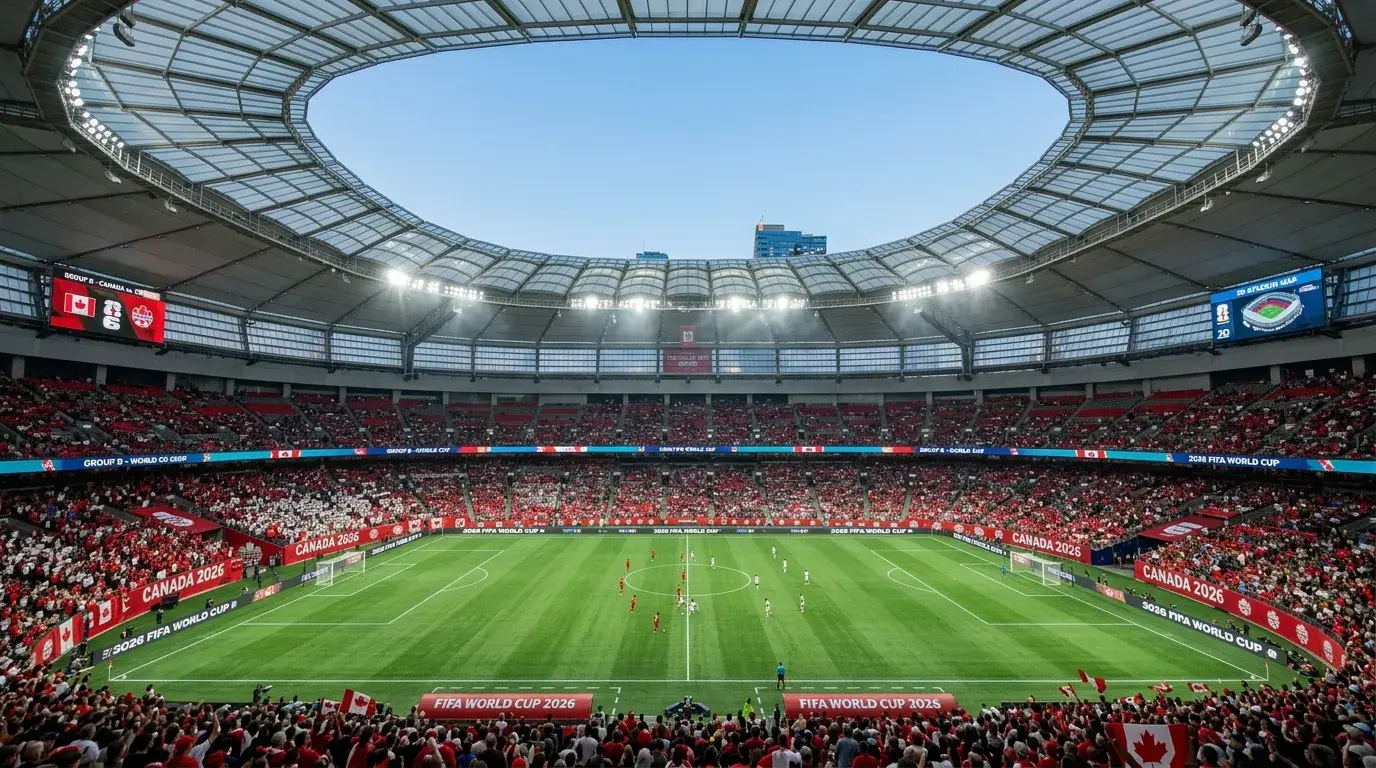
A co-host nation desperate to make history. A perennial European dark horse with knockout-round pedigree. The previous tournament’s host seeking redemption. A Balkan side with flair and fragility in equal measure. Group B assembles four teams whose ambitions and anxieties intersect in fascinating ways. For nine years I’ve analysed World Cup groups, and this particular combination strikes me as the tournament’s most evenly matched pool — four teams separated by fine margins, where individual moments will determine final standings.
Canada enters as co-hosts with expectations that dwarf their World Cup history. Switzerland brings the consistent quality that has delivered Round of 16 appearances in four of the last five tournaments. Qatar must overcome the disappointment of their 2022 home performance, where they became the first host nation eliminated at the group stage. Bosnia and Herzegovina qualified through a demanding European campaign, demonstrating resilience that could translate to tournament success. No team in Group B is clearly superior, and no team is clearly overmatched. This parity creates betting markets where thoughtful analysis genuinely outperforms casual punting.
Canada: A Nation’s Football Awakening
When Alphonso Davies sprinted down the left flank during World Cup qualifying, I saw something that Canadian football had lacked for generations — genuine world-class talent. Davies alone transforms Canada’s ceiling, providing an attacking threat that belongs among Europe’s elite. His Bayern Munich pedigree validates the Canadian program’s development pathway, proving that North American players can compete at football’s highest levels. Around Davies, a generation of Canadian talents has emerged through MLS academies and European youth systems, creating squad depth that previous Canadian teams could only dream about.
Canada’s co-hosting status provides advantages that money cannot purchase. They’ll play their group matches on home soil, with Canadian supporters filling venues in Toronto and potentially Vancouver. The crowd energy, the familiar travel conditions, the absence of jet lag — these factors compound into meaningful tournament edges. For a nation making only their third World Cup appearance, and their first since 1986, home advantage becomes particularly valuable.
Tactically, Canada plays aggressive, high-pressing football that suits their athletic profiles. The system demands constant movement and energy, with forwards pressing from the front while midfielders cut passing lanes. When executing properly, Canada overwhelms opponents and creates chances through turnovers in dangerous areas. When execution falters, gaps appear behind the midfield that quality opponents exploit. Against Switzerland’s experienced players, Canada’s pressing will face its stiffest test.
The Canadian public’s expectations have risen dramatically since qualifying for 2022. That tournament ended in disappointment — zero points, zero goals, three losses — but the experience seasoned a young squad. Players who faced Belgium and Croatia at 22 years old now return at 26, with four additional years of European experience. The question isn’t whether Canada has improved, but whether improvement translates to World Cup points.
Betting markets price Canada at approximately $2.50 to win Group B, making them narrow second favourites behind Switzerland at $2.20. I consider these prices roughly fair, though Canada’s home advantage might be slightly undervalued. Canada to qualify at $1.45 reflects near-certainty of at least a third-place finish, while Canada to win the group offers mild value for believers in home-ground dominance.
Switzerland: Tournament Football’s Reliable Overachiever
Silence falls across Australian sports media whenever Switzerland plays at major tournaments. Nobody cares about Switzerland until they’re eliminating France on penalties or pushing Spain to extra time. Then, suddenly, analysts scramble to explain how this small Alpine nation consistently outperforms expectations. The answer isn’t complicated — Switzerland develops technically excellent players, organises them into disciplined systems, and executes game plans without emotional deviation. No drama, no excuses, just results.
The Swiss squad for 2026 represents a transitional generation. Xherdan Shaqiri, now 34, provides experience and set-piece quality but can’t drive matches as he once did. Granit Xhaka’s leadership remains central to Swiss identity, though his mobility has declined. Around these veterans, younger players like Noah Okafor and Dan Ndoye bring pace and directness that previous Swiss squads lacked. The blend creates a team that controls possession, defends compactly, and attacks through wide areas.
Switzerland’s tournament record since 2006 shows remarkable consistency: five Round of 16 appearances from six tournaments, missing only in 2010. They reach knockout rounds and lose to superior opponents without embarrassment. For Group B, this pattern suggests Switzerland will secure qualification but might not dominate. Winning the group requires beating Canada in a hostile environment, which feels like asking more than Switzerland typically delivers.
Against Qatar and Bosnia, Switzerland should secure the points needed for progression. Their tactical discipline counters Qatari technical play, while their composure under pressure frustrates Bosnia’s erratic brilliance. The key match comes against Canada, where Swiss pragmatism faces Canadian enthusiasm. If Switzerland earns a draw or victory in that fixture, group progression becomes nearly certain.
Current odds show Switzerland as slight Group B favourites at $2.20 to win the pool, with qualification priced at $1.35. These prices reflect Swiss consistency without accounting for Canadian home advantage. I consider Switzerland to qualify at $1.35 roughly fair value, while Switzerland to win the group at $2.20 requires them to overcome environmental factors that favour the hosts. For Australian punters, Switzerland to finish second at $2.50 might offer better risk-reward balance.
Qatar: Redemption or Repetition
Three matches. Zero points. One goal scored. Seven conceded. Qatar’s 2022 World Cup home performance stands as the worst by any host nation in tournament history, a statistic that burns in Qatari football memory. The billions invested in facilities, the decades of planning, the global spotlight — all culminated in group-stage elimination before the second round of fixtures concluded. Now, four years later, Qatar faces a different challenge: proving that 2022 was the exception, not the rule.
Qatar’s domestic league has continued developing, with Qatari clubs competing in Asian club competitions and national team players gaining experience against varied opponents. The coaching setup has been restructured, bringing fresh perspectives to tactical preparation. However, fundamental questions remain about Qatar’s ability to compete with teams from stronger confederations. Their Asian Cup success demonstrates regional quality, but World Cup football demands more.
The 2026 World Cup schedule places Qatar against tougher opposition than 2022’s group, which already proved too demanding. Canada and Switzerland both represent significant upgrades in quality over Ecuador and Senegal, while Bosnia provides European tactical sophistication that Qatar struggled to handle four years ago. The path to redemption runs through consistent defensive organisation and clinical finishing from limited chances — exactly the attributes Qatar lacked in 2022.
Realistic assessment suggests Qatar will struggle in Group B. Their squad ceiling doesn’t match Canada’s athleticism or Switzerland’s experience, and even against Bosnia, they face opponents with higher-quality players in key positions. Unless Qatar has fundamentally transformed since 2022, another difficult group stage awaits. The question becomes whether they can secure points rather than whether they can top the group.
Bookmakers price Qatar at $7.00 to win Group B and $3.00 to qualify. These odds reflect appropriate scepticism about Qatar’s World Cup competitiveness. For Australian punters, Qatar’s value lies in match-specific underdogs rather than group markets. Qatar to draw against Bosnia at approximately $3.50 offers a speculative position for those believing both teams will approach cautiously.
Bosnia and Herzegovina: Balkan Talent, Balkan Temperament
Bosnian football operates in extremes. Brilliant one match, bewildering the next. Capable of beating any opponent, capable of losing to anyone. This volatility defines Bosnian sporting culture, where passion sometimes overwhelms pragmatism and individual moments outweigh systematic approaches. For Group B opponents, Bosnia represents both opportunity and danger — a team you’d rather not face when they’re firing, but one you expect to defeat when concentration lapses.
The squad features players from top European leagues who’ve proven their quality in demanding competitions. Edin Džeko, now approaching his late thirties, provides experience and target-man qualities that Bosnia’s tactical system requires. Younger talents have emerged through European academy systems, bringing technical proficiency that complements the traditional Bosnian physical approach. The combination creates a squad capable of competing with anyone in Group B on their best day.
Bosnia’s qualifying campaign demonstrated both their potential and limitations. Convincing victories over weaker opponents were punctuated by frustrating draws and narrow defeats against direct competitors. The pattern suggests a team that rises to big occasions but occasionally fails to handle matches they should control. In World Cup group play, this inconsistency becomes particularly dangerous — one off-day can eliminate tournament hopes.
Against Canada and Switzerland, Bosnia will approach as underdogs, relying on defensive organisation and counter-attacking quality. These are roles that suit Bosnian temperament, where lower expectations reduce pressure and allow natural talent to express itself. Against Qatar, Bosnia becomes favourites, which historically produces mixed results. The expectation of victory sometimes leads to complacency that smarter opponents exploit.
Current odds price Bosnia at $5.50 to win Group B and $2.40 to qualify. I consider the qualification odds generous — Bosnia should accumulate enough points to reach the eight best thirds threshold, even if they finish behind Canada and Switzerland. For Australian punters, Bosnia to qualify at $2.40 represents reasonable value for those who believe in their quality while acknowledging their inconsistency.
Schedule Analysis and Match Importance
Group B fixtures unfold across Canadian venues, providing the hosts with consistent advantages throughout. Canada versus Bosnia on June 12th opens the group in Toronto, a fixture where Canadian energy meets Bosnian experience. Switzerland versus Qatar follows on June 13th in Toronto, establishing early group dynamics. The second round brings Canada versus Qatar on June 17th and Switzerland versus Bosnia on June 18th, both in Toronto. Final fixtures occur simultaneously on June 23rd: Canada versus Switzerland and Qatar versus Bosnia.
For Australian punters, Group B kick-off times fall into challenging overnight slots. The Toronto fixtures kick off between 4:00 AM and 8:00 AM AEST, requiring early alarms or late nights for live viewing. This timing reduces Australian recreational betting volume, potentially creating inefficiencies in markets dominated by North American and European money.
The crucial fixture is Canada versus Switzerland in the final round. If both teams have already qualified, rotation and tactical conservatism might produce a low-scoring draw. If one team needs points while the other has secured progression, tactical asymmetry creates opportunities for the motivated side. The simultaneous kick-off ensures no gaming of results, with Qatar versus Bosnia equally meaningful for final standings.
Predicted Standings and Betting Value
My projected Group B final standings show Switzerland first with seven points, Canada second with six points, Bosnia third with four points, and Qatar fourth with zero points. Switzerland’s experience edges them past Canada despite the home disadvantage, while Bosnia secures enough points to potentially progress as a best third. Qatar’s limitations repeat 2022’s pattern, though with slightly better defensive performances.
The best betting value in Group B lies in second-place and third-place markets. Canada to finish second at $2.60 offers value if you believe Swiss quality will prove decisive despite Canadian home advantage. Bosnia to finish third at $2.20 represents strong value given their qualification potential through the eight best thirds pathway. Switzerland to win Group B at $2.20 is roughly fair, while Canada to win at $2.50 requires them to overcome Swiss consistency.
Match-specific opportunities include Switzerland to beat Qatar comfortably (correct score 2-0 or 3-0), Canada to beat Bosnia by narrow margins, and the potential for a final-round draw between Canada and Switzerland if both have already qualified. Group B lacks the chaos potential of some pools, but its competitive balance creates markets where informed betting outperforms random selection. For analysis of all tournament pools, explore our complete World Cup 2026 groups breakdown.