
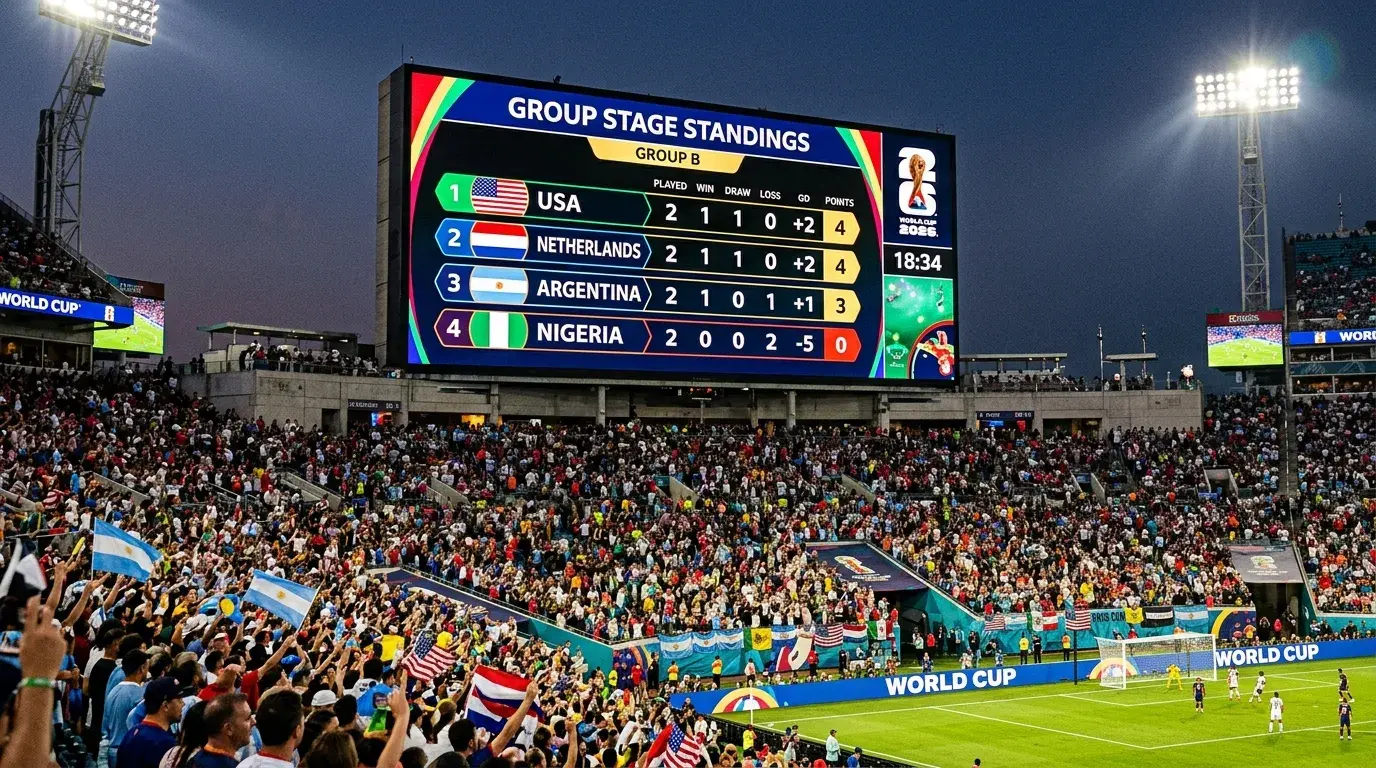
The draw ceremony in Zurich produced audible gasps from the Australian contingent when the Socceroos landed alongside the United States, Paraguay, and Turkey in Group D. Not the worst possible outcome — avoiding Brazil, Argentina, or France in the group stage counts as relative fortune — but far from the gentle passage some had hoped for. Every group at World Cup 2026 tells its own story, and the twelve chapters that unfold across the opening weeks will determine which nations chase glory and which return home early.
FIFA’s decision to expand to 48 teams required fundamental restructuring of the group stage format. Twelve groups of four teams replace the familiar eight groups, creating more qualification pathways while maintaining the three-match group format that has defined World Cups since 1998. The mathematics of advancement shifted dramatically: 32 teams progress to the knockout rounds, meaning two-thirds of participants will reach the elimination stage. This generosity extends to third-placed teams, with the eight best performers earning Round of 32 spots alongside automatic qualification for group winners and runners-up.
Understanding the World Cup 2026 groups requires examining both immediate composition and downstream implications. A team’s group opponents matter, but so does the bracket positioning that follows group stage completion. Some paths to the final run through significantly easier opposition than others, and smart punters map these possibilities before the tournament begins. Throughout this comprehensive guide, I analyse each group individually while connecting individual group dynamics to the broader tournament structure.
For Australian punters, Group D naturally commands closest attention. The Socceroos face legitimate group rivals in every match, with no clear favourite to top the table and no obvious candidate for elimination. This competitive balance creates both anxiety and opportunity — the kind of group where form, fitness, and fortune determine outcomes more than predetermined hierarchies.
How the Group Stage Works in 2026
The mechanics of World Cup group stages have remained consistent for decades, but the 2026 expansion introduces nuances that affect betting calculations. Each team plays three matches against their group opponents, earning three points for victory, one for a draw, and nothing for defeat. Total points determine standings, with goal difference, then goals scored, then head-to-head record resolving ties between teams level on points.
Top two finishers from each group advance automatically to the Round of 32. This creates 24 guaranteed knockout spots from the 12 groups. The remaining eight spots go to the best third-placed teams across all groups, ranked by points, then goal difference, then goals scored. Mathematically, four points almost certainly guarantees third-place advancement, while three points with positive goal difference should suffice in most scenarios.
The third-place pathway fundamentally changes group stage incentives compared to previous World Cups. Teams that lose their opening match no longer face elimination pressure in match two — collecting draws in their remaining fixtures may prove sufficient for advancement. I expect this safety valve to encourage more conservative tactical approaches, particularly from nations facing strong opponents early in the group stage. The urgency that produced attacking football and dramatic finishes in previous tournaments may decrease when survival through third place remains achievable.
Fixture scheduling creates its own dynamics within groups. Final round matches occur simultaneously within each group, preventing any team from knowing exactly what result they need before kick-off. However, the split across three host countries means some teams face significantly more travel than others. Group D, for instance, has Australia playing in Vancouver, Seattle, and Santa Clara — three West Coast cities with manageable distances. Other groups spread matches across Mexico, Canada, and the American East Coast, introducing fatigue variables that affect performance.
The knockout bracket follows a predetermined structure based on group finish position. Group winners from certain groups face runners-up from others, with third-place qualifiers slotted into remaining Round of 32 spots. This structure means identifying which groups feed into easier bracket paths provides value beyond just predicting group outcomes. A strong runner-up from one group may face tougher knockout opposition than a weak group winner from another.
Qualification Paths from Group Stage
Thirty-two teams advancing from 48 creates more forgiving mathematics than any previous World Cup. But understanding exactly how teams progress helps calibrate expectations for specific nations and markets. The pathway splits into three distinct routes: winning the group, finishing second, or qualifying as one of eight best third-placed sides.
Group winners enjoy the clearest path forward. Their Round of 32 opponent comes from a predetermined group runner-up or third-place qualifier, with seeding favouring their continued progress. Historical data shows group winners convert to quarter-final appearances at rates exceeding 70% — they face weaker opposition and carry momentum from successful group campaigns.
Group runners-up face more varied Round of 32 assignments. Some encounter third-place qualifiers from weaker groups, while others meet group winners from the opposite bracket half. The specific draw structure for 2026 determines which runner-up positions feed into favourable knockout paths, information that astute punters should map before betting on group markets.
Third-place qualification requires understanding the comparison criteria that determine which eight from twelve advance. Points come first, meaning a third-place team with four points ranks above one with three regardless of other factors. When points are equal, goal difference separates teams, followed by goals scored. Disciplinary records serve as the final tiebreaker, with fewer yellow and red cards proving advantageous.
The eight-team third-place ranking creates fascinating group stage endgames. A team assured of third place but unable to catch second may prioritise goal difference over attempting unlikely victory. Conversely, teams fighting to avoid fourth must calculate whether aggressive attacking or cautious defending better serves their advancement chances. These calculations differ from traditional World Cup group finishes and may produce unexpected tactical decisions.
For betting purposes, the “to qualify from group” markets encompass all three pathways. Understanding that third-place advancement is genuinely achievable — not merely theoretical — affects how to price teams in competitive groups. A quality nation drawing a tough group may still offer value in qualification markets because their third-place scenario remains live even if winning the group proves unrealistic.
Group A: Mexico, South Korea, South Africa, Czechia
Group A opens the tournament with Mexico hosting the first match at the legendary Estadio Azteca — a venue that has witnessed two previous World Cup finals and countless iconic moments. El Tri face South Africa in that opener, a fixture where home advantage should translate to comfortable victory and set the tone for Mexican group stage dominance.
South Korea arrive as the group’s second-strongest side, bringing recent World Cup experience and a squad featuring players from top European leagues. Their quarter-final run in 2002 as co-hosts demonstrated what Korean organisation and intensity can achieve when tournament momentum builds. Odds around 3.50 for group progression reflect genuine knockout-round capability.
South Africa return to the World Cup for the first time since hosting in 2010, when they became the first host nation eliminated in the group stage. Their qualification through CAF represents improved continental standing, though the squad lacks individual star power that might threaten group leaders. Realistic expectations centre on competitive performances rather than advancement.
Czechia qualify for their first World Cup since 2006, bringing European pedigree despite limited recent tournament experience. Their Euro 2020 quarter-final appearance demonstrated capability against continental opposition, translating to potential for points against Group A opponents. The match against South Korea may determine which team claims the second qualification spot.
Group B: Canada, Switzerland, Qatar, Bosnia and Herzegovina
Canada’s home World Cup places them as marginal group favourites despite limited tournament history. Their 2022 campaign produced promising performances without results — zero points and zero goals barely reflected competitive displays against Belgium, Croatia, and Morocco. Home advantage and two years of additional development suggest improved outcomes.
Switzerland bring consistent tournament performance that defies their modest population and football infrastructure. Quarter-final appearances at both Euro 2020 and Euro 2024 establish genuine knockout credentials. Their defensive organisation and clinical counter-attacking make them dangerous opponents for any group rival, with odds around 2.50 for qualification reflecting near-certainty of advancement.
Qatar’s 2022 hosting produced winless group stage elimination despite years of intensive preparation. The experience of tournament football, however disappointing the results, should inform improved 2026 performance. Their Asian Cup successes demonstrate competitive quality within their confederation, though translating that to World Cup level remains unproven.
Bosnia and Herzegovina debut at their second World Cup following their 2014 appearance in Brazil. That tournament saw group stage elimination despite competitive performances, a baseline they aim to exceed. Their Balkan technical tradition produces entertaining football that could trouble any Group B opponent on favourable days.
Group C: Brazil, Morocco, Scotland, Haiti
Brazil’s presence transforms Group C into a straightforward proposition for the five-time champions. Their quality should translate to nine points from three matches, with the intrigue focusing on which other team claims second place. This clarity affects group betting markets, where backing Brazil to win the group offers minimal return while second-place markets provide genuine uncertainty.
Morocco’s 2022 semi-final run established them as African football’s leading light. Their organised defensive structure and counter-attacking threat troubled every opponent, including two victories over European opposition. Whether they can replicate that form without home-continent advantage and with greater expectation represents the key question for their Group C prospects.
Scotland return to the World Cup for the first time since 1998, ending a 28-year absence that had become national obsession. Their qualification through European playoffs demonstrated competitive capability against continental rivals. Group C presents daunting challenges — Brazil away and Morocco would test any nation — but Scotland need only one strong result to keep advancement hopes alive.
Haiti’s World Cup return after 52 years creates the group’s primary storyline for neutral observers. Their qualification against CONCACAF opposition represented remarkable achievement, though the quality gap against Group C opponents suggests competitive performances rather than points collection. Every moment on the World Cup stage will be celebrated regardless of results.
Group D: USA, Paraguay, Australia, Turkey
Group D generates more Australian interest than any World Cup draw in Socceroos history. The combination of host nation United States, South American qualifier Paraguay, and European dark horse Turkey creates a competitive environment where any team could reasonably finish anywhere from first to fourth. This parity explains why bookmakers struggle to separate the four nations in qualification odds.
The United States enter as marginal favourites based on home advantage rather than clear quality superiority. Their squad features European-based talent across multiple top leagues — Christian Pulisic at Milan, Weston McKennie at Juventus, Tyler Adams bouncing between Premier League clubs. Home crowds and familiar conditions compound to create their best-ever World Cup opportunity, with odds around 1.80 for group winners reflecting that assessment.
Paraguay qualified through South American preliminaries that rank among football’s most competitive. Their technical tradition and defensive discipline make them difficult opponents regardless of the stage. Paraguay’s World Cup history includes quarter-final appearances in 1998 and 2010, demonstrating tournament capability that their current odds around 3.00 for qualification may undervalue.
Australia’s Group D placement offers genuine hope after qualification drama that extended until the final possible moment. Tony Popovic’s tactical direction provides clearer identity than previous campaigns, while emerging talents like Nestory Irankunda suggest attacking threat beyond historical Socceroos reliance on set pieces and defensive organisation. The detailed Group D analysis explores Australia’s specific pathway in greater depth.
Turkey bring European quality and tournament experience to complete the quartet. Their Euro 2024 campaign demonstrated capacity to compete with continental heavyweights, while their passionate supporter base will travel in numbers to North American venues. As Group D’s third seed behind USA and Paraguay but ahead of Australia, Turkey occupy an awkward positioning that could see them exceed or disappoint expectations depending on opening match outcomes.
Match schedule favours Australian viewing times more than most World Cup groups historically. The Turkey opener in Vancouver kicks off at 2:00 PM AEST on Saturday — a civilised hour for full national engagement. The USA fixture in Seattle requires 5:00 AM alarms, while the Paraguay match in Santa Clara starts at noon. This scheduling enables serious punter engagement with live betting markets across all three Socceroos fixtures.
Group E: Germany, Curaçao, Ivory Coast, Ecuador
Germany’s Euro 2024 home elimination shocked expectations, but World Cup redemption begins against opponents who should not extend them significantly. Curaçao’s presence as the smallest nation ever to qualify creates clear group hierarchy — Die Mannschaft need three victories to restore confidence and demonstrate the rebuild has progressed beyond continental disappointment.
Ivory Coast enter their best World Cup cycle in years following African Cup of Nations triumph in early 2024. That tournament success came through resilience rather than overwhelming quality, with knockout victories built on defensive solidity and clinical finishing. Their odds around 4.00 for group progression reflect genuine competitiveness against Ecuador and potentially troubling Germany if circumstances align.
Ecuador’s qualification through CONMEBOL’s gruelling process demonstrates consistent quality against South American opposition. Their 2022 World Cup saw group stage elimination after opening with victory over Qatar and collecting draws against Netherlands and Senegal. Improved results require converting competitive performances into points against European opposition.
Curaçao’s qualification represents Caribbean football’s greatest achievement. Their population of approximately 150,000 makes them by far the smallest nation at any World Cup, with odds beyond 500.00 appropriately pricing their tournament victory chances as essentially zero. Value in Curaçao markets exists in specific match contexts rather than overall tournament outcomes.
Group F: Netherlands, Japan, Tunisia, Sweden
Group F presents one of the tournament’s most competitive quartet outside the obvious Groups of Death. Netherlands bring historical pedigree and current squad quality, but Japan’s proven World Cup capability and Swedish tactical discipline prevent comfortable Dutch progression. Tunisia complete a group where any team could realistically claim any position.
The Dutch arrive as clear group favourites with odds around 1.50 for qualification. Their quarter-final exit in 2022 via penalty shootout against Argentina demonstrated competitive credentials without ultimate success. Squad evolution has produced younger talents capable of tournament breakthrough, though whether they can avoid the knockout drama that has defined recent Dutch World Cup exits remains uncertain.
Japan have beaten Germany and Spain in recent World Cup group stages — a record that should terrify Group F opponents. Their pressing intensity and technical precision produce results against teams that underestimate Asian football quality. Odds around 2.50 for qualification reflect their established tournament credentials.
Sweden return to the World Cup after missing 2022 qualification. Their tactical structure and set-piece threat create specific dangers that cause problems for any opponent. Whether their squad retains sufficient quality after several retirements from the 2018 quarter-final team determines their Group F ceiling.
Tunisia provide African representation in Group F, bringing organised defensive play and tournament experience from four previous World Cup appearances. Their 2022 group stage included a famous victory over France’s second-string, demonstrating capacity for notable results when circumstances align.
Group G: Belgium, Egypt, Iran, New Zealand
Belgium’s “Golden Generation” has definitively ended following 2022 World Cup disaster and subsequent rebuilding. The 2026 version features regenerated personnel seeking to establish new identity rather than chase past glories. Group G opponents should not trouble them significantly, but expectation levels have appropriately recalibrated after their previous failures.
Egypt bring African Cup of Nations pedigree and individual brilliance through Mohamed Salah to World Cup competition. Their 2018 appearance ended with three defeats and early elimination, though that campaign coincided with Salah carrying injury throughout. A fit Salah changes Egyptian capability entirely, with odds around 3.50 for qualification reflecting their genuine competitiveness.
Iran’s consistent World Cup qualification from Asia demonstrates regional supremacy without translating to tournament success. Their defensive organisation frustrates opponents while limiting attacking output, producing low-scoring matches where single goals determine outcomes. Group G opponents may find Iranian fixtures more challenging than their FIFA ranking suggests.
New Zealand represent Oceania at the World Cup for the first time since 2010, when they famously drew all three group matches including a result against eventual champions Italy. The All Whites enter Group G as clear fourth favourites but with proud tradition of competitive performances that belie their outsider status.
Group H: Spain, Cape Verde, Saudi Arabia, Uruguay
Spain’s Euro 2024 triumph announced the arrival of their next generation — Lamine Yamal, Nico Williams, and Pedri lead a squad combining established excellence with emerging brilliance. Group H opponents face the tournament’s most technically accomplished side, where Spanish possession dominance should translate to comfortable victories regardless of opposition.
Uruguay bring South American pedigree and tournament experience to Group H, with Darwin Núñez providing the individual threat that creates knockout-round possibility. Their defensive tradition produces organized football that troubles any opponent, with odds around 2.50 for qualification reflecting genuine second-place potential behind Spain.
Saudi Arabia shocked Argentina in 2022’s opening match but subsequently lost to Poland and Mexico, demonstrating inconsistency that defines their World Cup presence. That victory established possibility against group favourites, a psychological template they will attempt to replicate against Spain despite the overwhelming quality gap.
Cape Verde debut at the World Cup as African qualifiers, bringing island nation pride to Group H. Their journey through CAF qualification defeated established African football nations, suggesting competitive capability beyond their FIFA ranking. Like fellow debutants, every World Cup moment represents historic achievement regardless of results.
Group I: France, Senegal, Norway, Iraq
France dominate Group I projections as clearly as any nation in the tournament. Consecutive World Cup final appearances establish Les Bleus among the absolute elite, with Kylian Mbappé leading a squad whose second-choice players would start for most other nations. Group I opponents face near-impossible challenges against French quality.
Senegal carry African hopes following Morocco’s 2022 breakthrough. Their 2022 campaign ended in Round of 16 elimination to England, but group stage progression including victory over Ecuador demonstrated competitive credentials. With Sadio Mané’s influence diminished, identifying new leaders determines their 2026 ceiling.
Norway reach the World Cup for the first time since 1998, with Erling Haaland finally appearing on football’s biggest stage. His presence transforms Norwegian capability entirely — a player capable of single-handedly overwhelming opponents if supplied properly. Group I opponents must contend with both French dominance and Haaland’s threat, creating fascinating dynamics for second-place calculations.
Iraq qualify for their first World Cup since 1986, representing Asian football’s growth beyond traditional powerhouses. Their AFC qualification campaign included notable results against established continental rivals, suggesting competitive quality that may produce respectable performances against Group I opponents.
Group J: Argentina, Algeria, Austria, Jordan
Defending champions Argentina headline Group J with Lionel Messi potentially playing his final World Cup matches. The 2022 triumph established this generation among all-time greats, but repeating that success requires defeating the field again — starting with group stage opponents who may prove more competitive than their seedings suggest.
Algeria missed 2022 qualification but return for 2026 as African representatives seeking improved tournament performance. Their 2014 campaign reached the Round of 16 before narrow defeat to Germany, establishing baseline expectations for progression. Odds around 4.50 for qualification reflect genuine possibility against Austria and Jordan.
Austria bring European quality and tournament experience from Euro 2024 participation. Their tactical discipline under Ralf Rangnick produces organised performances that could trouble any opponent, including Argentina if circumstances align favourably. Group J’s second-place race may come down to goal difference between Austria and Algeria.
Jordan debut at the World Cup following qualification through Asian playoffs. Drawing Argentina in the opener represents maximum difficulty, but subsequent matches against Austria and Algeria offer more realistic points collection opportunities. Every moment on the World Cup stage represents historic achievement for Jordanian football.
Group K: Portugal, Uzbekistan, Colombia, DR Congo
Portugal transition into the post-Cristiano Ronaldo era at a World Cup for the first time. Rafael Leão, Bruno Fernandes, and Bernardo Silva lead a squad maintaining Portuguese quality standards without the singular focus on one legendary player. Group K opponents face evolved Portuguese football that may prove more collectively dangerous than previous versions.
Colombia return to the World Cup following 2022 qualification failure. Their traditional technical quality and competitive CONMEBOL experience suggest genuine knockout-round capability. Odds around 2.00 for qualification reflect near-certainty of progression, with group winner markets offering the meaningful uncertainty.
Uzbekistan debut at the World Cup as Asian qualifiers, bringing Central Asian football to global attention. Their qualification through AFC demonstrated improved regional standing, though the quality gap against European and South American opposition represents the primary challenge. Every competitive performance advances Uzbek football’s development.
DR Congo qualify for their first World Cup since 1974 when they competed as Zaire. That campaign produced an 0-9 defeat to Yugoslavia that remains World Cup history’s joint-heaviest loss. The 2026 version arrives with genuine competitive ambition rather than mere participation, seeking to establish African credentials against Group K opponents.
Group L: England, Croatia, Ghana, Panama
Group L produces the tournament’s clearest “Group of Death” designation outside Group D’s competitive balance. England and Croatia both harbour genuine tournament ambitions, while Ghana’s World Cup pedigree and Panama’s North American quality create a quartet where any outcome seems possible.
England enter as group favourites with odds around 1.30 for qualification. Three consecutive semi-final or better finishes across major tournaments establish their credentials beyond reasonable doubt. Whether they can convert consistent deep runs into actual trophy lifting remains the defining question, but Group L progression should not challenge that pursuit.
Croatia punched absurdly above their population weight by reaching the 2018 final and 2022 semi-final. Their midfield quality through Luka Modrić and supporting cast produces controlled football that troubles any opponent. Odds around 2.00 for qualification reflect genuine competitiveness against England, with head-to-head results potentially determining group winner.
Ghana bring African World Cup experience across multiple campaigns, including quarter-final heartbreak in 2010 when Asamoah Gyan’s missed penalty against Uruguay prevented history. Their 2022 campaign included competitive defeats to Portugal and Uruguay alongside victory over South Korea. Group L represents their toughest assignment yet.
Panama return to the World Cup following their 2018 debut, where they lost all three matches while celebrating mere qualification as national triumph. The 2026 version arrives with improved ambition, seeking points collection rather than just participation. Group L’s quality gap suggests progression remains unlikely, but competitive performances could produce memorable moments.

Groups of Death Identified
The traditional “Group of Death” designation applies when multiple strong teams share the same group, guaranteeing at least one quality nation fails to advance. The 48-team format with third-place qualification reduces elimination probability for strong sides, yet certain groups still present dramatically more challenging pathways than others.
Group L stands alone as the clearest death group. England and Croatia would both expect semi-final appearances in favourable draws, yet share a group where one will finish behind the other and face immediate knockout challenges. Ghana’s quality adds genuine fourth-place risk for either European heavyweight, while Panama provides potential for shock results against complacent opponents. Backing either England or Croatia to win Group L offers real uncertainty despite their quality.
Group F presents the tournament’s deepest competitive balance. Netherlands, Japan, Sweden, and Tunisia all possess genuine knockout-round credentials. Japan’s recent World Cup performances include victories over Germany and Spain — results that should make Netherlands cautious about group topping assumptions. This competitive depth creates value in markets where bookmakers underestimate the weaker seeds.
Group D affects Australian interest directly, and objective assessment places it among the toughest assignments. USA, Paraguay, Australia, and Turkey all possess legitimate qualification claims without any side clearly separating from the pack. The absence of a dominant favourite means fourth place is equally achievable as first — uncomfortable parity that makes Group D betting particularly challenging.
Groups containing Brazil, Argentina, France, and Spain conversely represent the tournament’s gentlest passages. These nations should collect maximum points through the group stage, with intrigue limited to which other teams claim second place. Betting on these groups focuses on qualification markets beyond the obvious group winner rather than outright outcomes.
Easiest Paths to Knockout Rounds
Bracket positioning matters as much as group composition when projecting tournament pathways. A team’s Round of 32 opponent depends on their group finish position and which third-place qualifiers slot into available positions. Mapping these possibilities before the tournament begins identifies where bracket advantages exist.
Group A winners face favourable Round of 32 assignments based on current bracket structure, potentially meeting third-place qualifiers from groups lacking heavyweight presence. Mexico’s hosting advantage compounds this bracket fortune, making them attractive for deep tournament run betting at odds around 60.00 that price significant progression potential.
Groups on the bracket’s less congested half avoid potential meetings with multiple contenders until later rounds. Specifically, Group C (Brazil’s group), Group E (Germany), and Group K (Portugal) feed into a bracket section that may produce easier quarter-final and semi-final opponents than the opposite side containing Argentina, France, and England. Detailed bracket analysis identifies these asymmetries.
Third-place qualification creates unpredictable bracket slotting that can produce advantageous or disastrous Round of 32 draws. A strong third-place team from a competitive group may face easier opposition than a weak group winner from a softer group, depending on how the eight third-place qualifiers are distributed. This randomness affects tournament winner markets more than group stage betting.
Setting Group Stage Expectations
The 2026 World Cup groups present more competitive balance than any previous tournament, a natural consequence of expanding to 48 teams while maintaining four-team group structure. Traditional powers no longer dominate single groups entirely — the third-place pathway ensures quality teams have viable advancement routes even in death groups.
For betting purposes, group stage markets offer distinct value opportunities compared to outright tournament betting. The shorter timeframe — three matches rather than potential seven for tournament winners — reduces variance while still providing meaningful profit potential. Focus on qualification markets where your assessment diverges from bookmaker pricing, particularly for teams whose third-place pathway you evaluate more favourably than odds suggest.
Australian punters should study Group D intensively while maintaining perspective on groups without emotional attachment. The Socceroos’ matches will generate maximum domestic interest and betting volume, meaning bookmaker margins may be tighter and value harder to find. Other groups — particularly those in death group categories — may offer superior opportunities for punters willing to research beyond national team interests.
The complete team profiles provide deeper context for assessing individual nations within their group assignments. Understanding team quality, recent form, and tournament history informs probability assessments that translate to betting value when diverging from market consensus. Use this group overview as starting point for targeted research into specific nations and markets that interest you.