

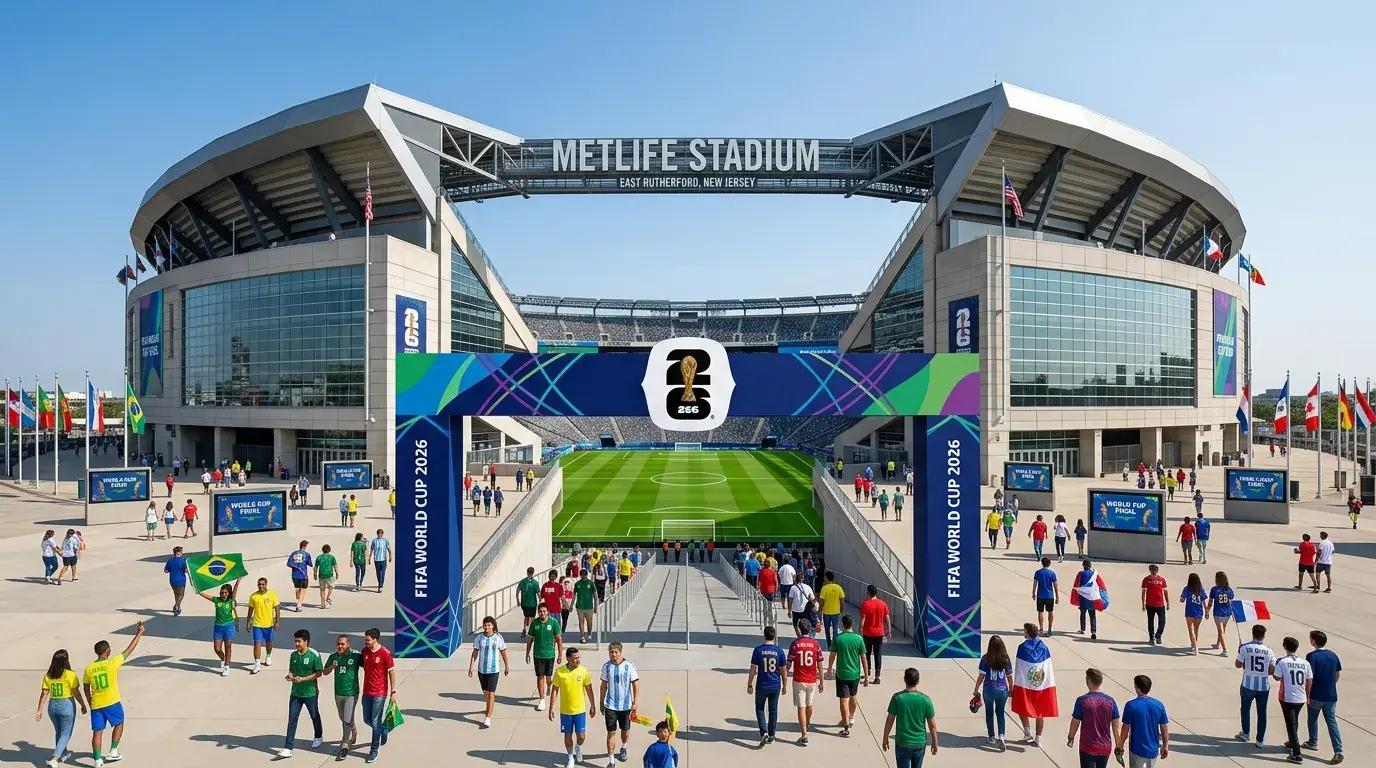
On 19 July 2026, MetLife Stadium will host football’s grandest occasion — the FIFA World Cup Final. Two nations will contest ninety minutes (perhaps one hundred twenty) that determines which country lifts the most coveted trophy in sport. For Australian punters watching from the other side of the world, that final will kick off around 9:00 AM AEST on a Monday morning — manageable timing for the dedicated who’ve followed the tournament from its opening whistle in Mexico City thirty-nine days earlier.
MetLife Stadium’s selection as the final venue reflects American football infrastructure’s scale and sophistication. Located in East Rutherford, New Jersey — technically outside New York City but marketed as the New York/New Jersey metropolitan area — the stadium provides capacity, accessibility, and facilities that FIFA demands for its showcase event. Understanding this venue helps Australian punters assess match conditions that might influence final betting decisions when the tournament reaches its climax.
Stadium Overview and History
MetLife Stadium opened in 2010 as the shared home of the New York Giants and New York Jets — two NFL franchises whose combined fanbases justified the approximately $1.6 billion construction cost that made it among the most expensive stadiums ever built. The stadium replaced the adjacent Giants Stadium, which had hosted the 1994 World Cup including the final where Brazil defeated Italy on penalties. This heritage established the venue as proven World Cup territory, though the modern incarnation represents significant infrastructure advancement over its predecessor.
The stadium’s design prioritises American football’s requirements while accommodating soccer’s different demands. The natural grass surface — unusual for NFL venues that typically use artificial turf — provides playing conditions that international footballers prefer. Sightlines optimise American football viewing, with seating configurations that maintain reasonable angles for soccer’s wider pitch dimensions. The compromise produces workable rather than ideal football viewing, though capacity compensates for sightline limitations.
MetLife Stadium’s location in New Jersey’s Meadowlands complex provides transportation infrastructure that Manhattan’s density cannot match. Parking for over 28,000 vehicles surrounds the venue, while rail connections link to New York Penn Station for those preferring public transport. International visitors will find the venue accessible from Newark Liberty International Airport — a practical consideration for the global audience that World Cup finals attract.
Climate considerations distinguish MetLife from enclosed American venues. As an open-air stadium without retractable roof, weather becomes a factor for July fixtures. New Jersey summers deliver hot, humid conditions that test players’ endurance over ninety-plus minutes. Occasional afternoon thunderstorms can delay fixtures, though evening kick-offs reduce weather interference likelihood. The final’s 4:00 PM local time scheduling places it during peak afternoon heat — a factor that influences match tempo and playing styles.
World Cup 2026 Matches at MetLife Stadium
MetLife Stadium will host eight World Cup 2026 matches including the final — the maximum allocation for any single venue. This fixture density reflects FIFA’s confidence in the stadium’s capacity to deliver repeated excellence throughout the tournament. Group-stage matches establish the venue’s atmosphere before knockout rounds intensify the stakes culminating in football’s ultimate fixture.
The group-stage allocation includes fixtures from multiple groups, spreading supporter communities across early-round matches. These fixtures provide opportunity to assess pitch conditions, stadium atmosphere, and operational efficiency before knockout rounds demand perfection. For betting purposes, early MetLife matches reveal whether the surface suits technical passing or favours direct play — information that informs later-round predictions.
Knockout-round matches at MetLife Stadium carry increasing significance through the tournament’s elimination phases. The venue will host at least one Round of 32 fixture, potentially quarter-final matches, and semi-finals before the tournament’s conclusion. Each knockout fixture tests different aspects of stadium operations — crowd management, security protocols, broadcast requirements — that build toward final-day readiness.
The final itself represents MetLife Stadium’s definitive moment. FIFA’s operational requirements transform the venue for the occasion — expanded media facilities, enhanced security perimeters, ceremonial staging that the World Cup’s conclusion demands. The stadium’s American football identity temporarily surrenders to football’s global celebration, creating an atmosphere that participants will remember regardless of result.
Technical Specifications and Playing Conditions
MetLife Stadium’s capacity for World Cup 2026 will be approximately 82,500 — slightly reduced from NFL configurations due to FIFA pitch dimension requirements. This capacity places it among the tournament’s largest venues, ensuring that the final attracts the maximum possible live audience. The atmosphere generated by 82,000 supporters creates acoustic intensity that influences match dynamics regardless of neutral allocation.
The playing surface at MetLife Stadium uses natural grass that FIFA mandates for World Cup fixtures. Unlike artificial surfaces that provide predictable ball behaviour, natural grass introduces variability based on weather conditions, match frequency, and maintenance quality. The stadium’s grass system includes underground heating and drainage that maintains surface quality through varying conditions, though July heat places stress on any natural surface.
Pitch dimensions for World Cup matches will measure 105 metres by 68 metres — FIFA’s standard international dimensions. American football’s narrower field requires temporary expansion for soccer, with the sidelines extending closer to stands than NFL configurations allow. This proximity enhances atmosphere but reduces space for attacking play near touchlines — a subtle factor that influences tactical approaches.
Lighting systems at MetLife Stadium provide the illumination standards that modern broadcasting requires. Evening fixtures benefit from optimal lighting conditions without shadow interference from structural elements. The stadium’s open design allows natural light during afternoon matches, with supplementary lighting maintaining consistency as daylight fades. For the final’s late afternoon kick-off, lighting conditions will transition during the match itself.
Location, Transport, and Accessibility
MetLife Stadium’s East Rutherford location places it approximately 13 kilometres from Manhattan — close enough for New York association but distant enough for suburban infrastructure advantages. The Meadowlands Sports Complex surrounding the stadium provides the parking and transport networks that urban venues cannot accommodate. This separation from Manhattan creates logistical considerations for international visitors expecting New York City accessibility.
Transport options to MetLife Stadium include New Jersey Transit rail services from Penn Station running on expanded match-day schedules, direct bus routes from the Port Authority Bus Terminal with dedicated World Cup services, and extensive parking for those with vehicle access. Match-day transport schedules expand to accommodate 82,000 departures over several hours, though post-match congestion remains inevitable regardless of operational efficiency and advance planning. For international visitors, planning return transport proves essential — the stadium’s suburban location complicates spontaneous travel decisions that might work in Manhattan.
Newark Liberty International Airport provides the most convenient air access, located approximately 20 kilometres from the stadium. John F. Kennedy and LaGuardia airports offer Manhattan access but add complexity for MetLife travel. International visitors should consider accommodation location relative to both stadium and airport access — the New Jersey side offers proximity at the expense of Manhattan’s attractions.
Accessibility features at MetLife Stadium comply with American disability standards that exceed many international requirements. Wheelchair seating disperses throughout the venue rather than concentrating in limited sections. Accessible parking, restrooms, and concession areas provide comprehensive accommodation. For Australian visitors with accessibility needs, MetLife Stadium’s compliance with ADA standards ensures participation in the final’s atmosphere without infrastructure barriers.
Weather and Climate Considerations
July in New Jersey delivers summer conditions that challenge players and supporters alike throughout match durations. Average high temperatures reach 29-31°C with humidity levels that make conditions feel significantly warmer on exposed skin. Afternoon matches experience peak heat that affects playing tempo and substitution strategies throughout the second half. Evening fixtures provide welcome relief as temperatures moderate, though humidity often persists well past sunset.
The World Cup Final’s 4:00 PM local kick-off places play during afternoon heat before evening relief arrives. Match tempo might slow as fatigue accumulates, favouring teams with superior squad depth who can introduce fresh legs from the bench. Hydration breaks — now standard in FIFA competitions under certain temperature thresholds — might interrupt play rhythm in ways that influence tactical approaches and betting outcomes.
Thunderstorm potential exists throughout New Jersey summers, though meteorological forecasting accuracy allows operational planning that minimises disruption. FIFA’s contingency protocols for weather delays ensure match completion regardless of interruption, though delays influence live betting markets and match dynamics in unpredictable ways. The final’s scheduling provides flexibility for weather delays without compromising broadcast obligations.
For Australian punters assessing MetLife Stadium conditions, the key consideration involves heat’s impact on match tempo. Technical teams who control possession while conserving energy might gain advantages over direct approaches that demand continuous high-intensity running. The final’s conditions favour patient football — a factor worth considering when evaluating semi-final winners’ stylistic compatibility with the venue.
Betting Considerations for MetLife Stadium Matches
Stadium-specific factors influence betting decisions beyond team quality assessments. MetLife Stadium’s open-air configuration introduces weather variables that enclosed venues eliminate. The natural grass surface suits technical play while potentially challenging teams whose domestic football occurs on artificial surfaces. These factors create marginal advantages worth incorporating into betting analysis.
The atmosphere generated by 82,000 supporters creates intensity that influences player performance regardless of neutral allocation. Knockout matches at MetLife Stadium will feature split supporter sections whose collective energy affects match dynamics. For the final, neutral supporters often favour underdog narratives — atmospheric support that might boost confidence for teams facing favoured opponents.
Historical performance at MetLife Stadium provides limited football data given its primary NFL usage. The venue’s 1994 World Cup predecessor offers some context — technical South American teams performed well in New Jersey conditions — though infrastructure differences between the stadiums limit direct comparison. For betting purposes, treat MetLife Stadium matches as neutral-ground propositions where team quality matters more than venue familiarity.
Under/over markets for MetLife Stadium matches should account for heat impact on match tempo. Afternoon fixtures in July conditions might produce fewer goals as teams conserve energy rather than pursuing aggressive attacking play. Consider under 2.5 goals positions for daytime matches where heat restricts the continuous pressing that creates scoring opportunities. Evening fixtures allow normal tempo expectations.
The Final: Historical Significance and Betting Context
World Cup finals carry historical weight that ordinary matches cannot approach regardless of participating teams. The ninety minutes (or more) that determine global champions become part of football’s permanent record, discussed for generations regardless of contemporary significance at the time. MetLife Stadium’s final will join 1994’s Rose Bowl final in American World Cup memory, establishing New York/New Jersey as proven hosts for football’s greatest occasion and the world’s most-watched single sporting event.
For Australian punters, the final’s 9:00 AM AEST Monday kick-off provides manageable viewing opportunity. Live betting markets will fluctuate throughout the match as momentum shifts between finalists. Pre-match positions established during semi-final analysis will face the ultimate test — whether assessed quality translates to performance under maximum pressure.
The final’s unique dynamics include psychological factors absent from earlier knockout rounds. Trophy proximity affects decision-making differently than elimination threat in earlier matches throughout the tournament. Teams might approach the final more cautiously than semi-finals, producing tactical contests where single goals prove decisive rather than open exchanges. Consider draw after ninety minutes positions at approximately $3.00 that capture the final’s typical caution between evenly-matched finalists. For comprehensive tournament betting strategies, see our complete World Cup 2026 betting guide.
