

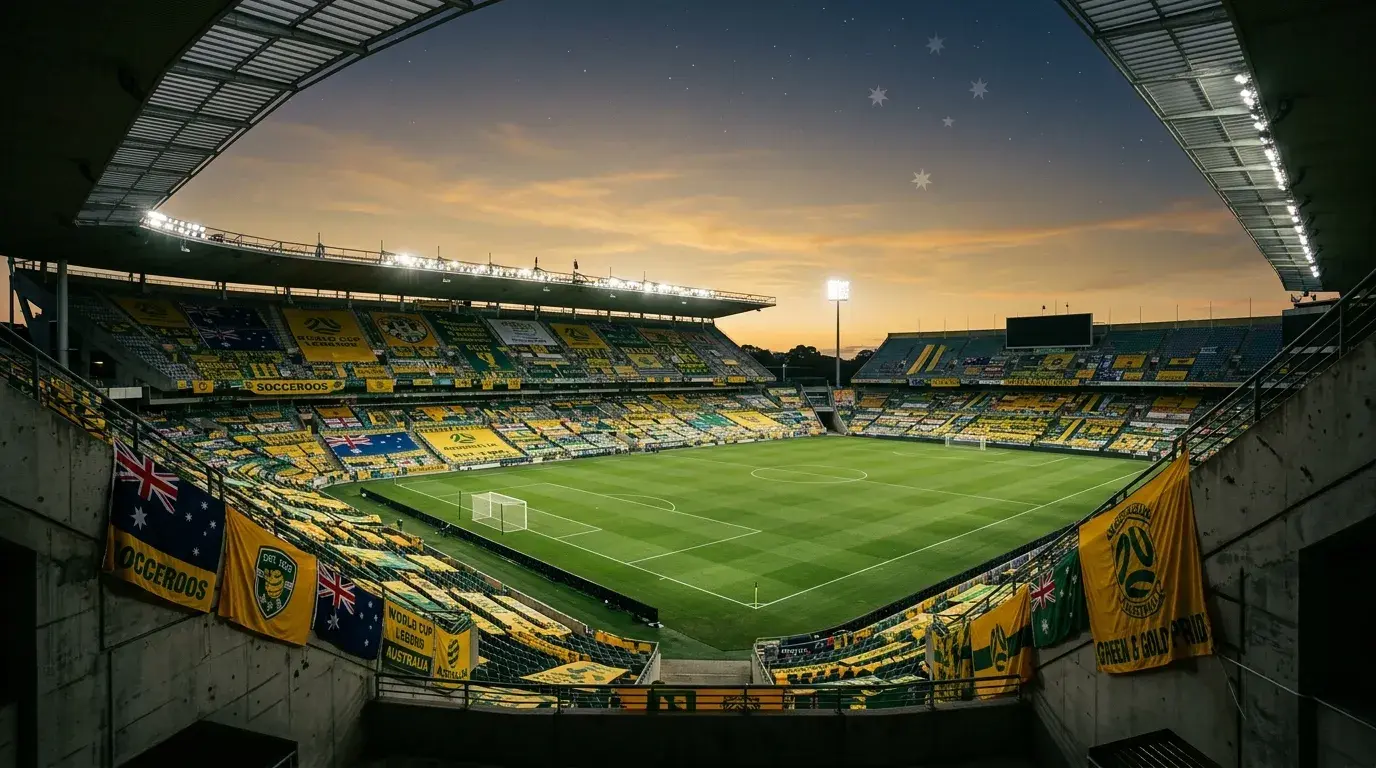
The night of June 22, 2006, changed Australian football forever. I was seventeen, watching in a packed Melbourne pub as Tim Cahill rose to head home a 84th-minute equaliser against Croatia. We didn’t just qualify from our group that night – we announced to the world that Australia belonged on football’s grandest stage. That campaign, and the decades of heartbreak and triumph surrounding it, forms a story every Socceroos supporter should know. Understanding Australia’s World Cup history illuminates where we’ve been, what we’ve achieved, and why the 2026 tournament represents our best opportunity yet to write new chapters.
Six World Cup appearances across five decades barely capture the emotional weight this competition carries for Australian football. We’ve suffered agonising near-misses, endured thirty-two years in the wilderness, celebrated breakthrough victories, and experienced the full spectrum between despair and euphoria. The Socceroos’ relationship with the World Cup reflects football’s growth in Australia itself – from minority sport overshadowed by rugby codes to a genuine national passion consuming millions during tournament windows. This history matters because it shapes expectations, builds understanding, and connects each new generation to the struggles and triumphs that preceded them.
1974: The First Appearance
Australia’s World Cup story begins in West Germany, 1974, though the journey to get there proved more dramatic than anyone anticipated. The Socceroos needed to navigate Asian-Oceanian qualification before facing South Korea in a playoff for the continent’s single World Cup berth. A 0-0 draw in Sydney set up an away match in Seoul where Australia fell behind before Attila Abonyi equalised. With the aggregate tied 1-1, a neutral-site playoff in Hong Kong determined the qualifier. Ray Richards scored twice in a 2-1 victory that sent Australia to their first World Cup finals.
The tournament itself delivered harsh lessons. Drawn against East Germany, West Germany, and Chile, Australia faced three opponents with superior resources, tactical sophistication, and tournament experience. The opening match against East Germany ended 0-2 – a respectable scoreline against a team that would finish the tournament in third place. Chile provided the toughest psychological blow: Australia led through a second-half goal before conceding an equaliser in the dying minutes. The 0-0 draw against hosts West Germany seemed a moral victory, but the Germans had already qualified and fielded a weakened side.
Zero points from three matches. Zero goals scored. A goal difference of minus five. By statistical measures, the 1974 campaign was a failure. But the Socceroos returned home as pioneers who had achieved what no previous Australian team had accomplished. Johnny Warren, Peter Wilson, Adrian Alston, and their teammates established the foundation upon which every subsequent campaign was built. The players couldn’t have known they were beginning a story that would take half a century to reach its current chapter.
Betting markets barely registered Australia in 1974. The odds for outright victory would have been astronomical if anyone bothered to offer them. Match result betting existed in simpler forms, but the detailed markets modern punters enjoy hadn’t developed. What the 1974 campaign established was credibility – proof that Australia could qualify for and compete at the World Cup, even if results didn’t follow immediately.
The Long Wait of 1978-2002
Thirty-two years. Eight consecutive World Cups passed without Australian participation. The near-misses during this era haunt supporters who lived through them, each failure etching deeper frustration into the national football psyche. Understanding this wilderness period contextualises why subsequent qualification felt so momentous and why Australian football treats World Cup participation as precious rather than routine.
Scotland ended Australia’s 1986 hopes through a home-and-away playoff. The first leg in Glasgow saw Australia lose 2-0; a 0-0 draw in Melbourne sealed elimination. The 1994 campaign introduced even crueler mathematics: despite finishing level with Argentina in their intercontinental playoff, away goals sent the South Americans to USA ’94. Diego Maradona played in that tie; Australia fought credibly but lacked the quality to overcome such illustrious opposition on aggregate.
The 1998 qualification failure arguably hurt most. Australia reached an intercontinental playoff against Iran, requiring neutral-site matches in Melbourne. The first leg saw Australia trail before Mark Viduka equalised to salvage a 1-1 draw. The second leg descended into controversy and heartbreak: Iran scored twice in the final eleven minutes to win 2-1, breaking Australian hearts. Harry Kewell was nineteen years old that night, watching from the bench as qualification slipped away. He would have to wait another decade for World Cup redemption.
The 2002 campaign ended against Uruguay in another playoff. Australia dominated the home leg but only won 1-0. The return leg in Montevideo saw Uruguay equalise early before winning on penalties after a 0-0 draw in regulation and extra time. John Aloisi missed the decisive spot kick, a moment burned into Australian football memory. These near-misses accumulated into collective trauma – the sense that Australia was good enough to qualify but cursed to fall at the final hurdle.
During these thirty-two years, Australian football evolved dramatically. The National Soccer League gave way to the A-League in 2005, professionalising domestic football and developing talent in new ways. Players increasingly moved to European leagues, gaining experience that would prove crucial when qualification finally arrived. The wilderness years weren’t wasted – they were preparation, even if nobody knew when the drought would end.
2006: The Breakthrough
Guus Hiddink arrived in Australian football like a thunderclap. The Dutch coach took over with one mission: qualify for Germany 2006 after three decades of failure. What followed was the most successful period in Socceroos history, built on tactical intelligence, player management, and the accumulated frustration of every near-miss converted into furious motivation.
Qualification required an intercontinental playoff against Uruguay – the same opponent who had eliminated Australia in 2002. The first leg in Montevideo ended 1-0 to Uruguay, a scoreline that felt manageable after previous away disasters. The return leg at Stadium Australia drew 83,000 supporters, the largest crowd ever to watch football in Australia. Marco Bresciano equalised on aggregate in the first half; the match finished 1-0 after 120 minutes, sending the tie to penalties. John Aloisi – who had missed the decisive kick in 2002 – stepped forward and converted the winner. Redemption took concrete form in that single strike.
The tournament draw placed Australia in Group F with Brazil, Croatia, and Japan. Bookmakers priced the Socceroos around 150/1 for the tournament, modest among World Cup outsiders but reflecting genuine uncertainty about performance against elite opposition. The opening match against Japan became a turning point in Australian football perception: trailing 1-0 with six minutes remaining, Tim Cahill scored twice and John Aloisi added a third in stoppage time for a 3-1 victory that stunned observers worldwide.
Brazil dispatched Australia 2-0 in a match where the scoreline flattered the Seleção somewhat. The Croatia match decided group qualification: needing a draw to progress, Australia fell behind before Craig Moore converted a penalty. The 2-2 draw sent Australia through as Group F runners-up, marking the first time the Socceroos had progressed beyond a World Cup group stage. Against Italy in the Round of 16, a controversial late penalty awarded by referee Luis Medina Cantalejo gave Francesco Totti the chance to eliminate Australia in the 95th minute. He converted; Australia was out, but the campaign had exceeded every realistic expectation.
The 2006 World Cup produced the modern Socceroos identity. Harry Kewell, Tim Cahill, Mark Viduka, Lucas Neill, Mark Schwarzer – these names became synonymous with Australian football success. The tournament proved Australians could compete at the highest level, not merely participate. That proof transformed expectations and created the benchmark against which every subsequent campaign is measured.
2010 South Africa
Pim Verbeek replaced Hiddink with a mandate to consolidate the 2006 breakthrough. The Dutch coach implemented a defensive approach designed to keep matches tight and exploit counter-attacking opportunities. Qualification came through the Asian Football Confederation route, confirming Australia’s 2006 switch from Oceania to AFC had created a more challenging but more respected pathway to World Cups.
The group draw delivered Germany, Ghana, and Serbia – a difficult combination requiring pragmatic football to progress. Australia opened against Germany in Durban, falling 4-0 in a match that exposed the gap between Verbeek’s defensive system and genuine world-class opposition. Tim Cahill’s sending off early in the second half didn’t help, but Germany had already established dominance. The tactical approach that kept things tight against Croatia four years earlier simply couldn’t contain German precision.
Ghana provided the crucial test. A Brett Holman goal gave Australia a 1-1 draw that kept qualification hopes alive heading into the final group match against Serbia. Verbeek’s team needed victory to have any chance of progression; Serbia needed the same, having lost their opening two matches. Tim Cahill headed Australia in front, but Serbia equalised before halftime. Despite dominating the second half, Australia couldn’t find a winner. The 2-1 victory fell one goal short of overtaking Ghana on goal difference.
One point from three matches, with a negative goal difference. Statistically, South Africa 2010 resembled 1974 more than 2006. But context mattered: Australia had competed against tougher opponents, come within margins of qualification, and demonstrated that 2006 wasn’t a fluke. The 2010 campaign showed sustainable quality rather than one-tournament luck, even if results disappointed expectations inflated by the German breakthrough.
2014 Brazil
Ange Postecoglou took charge with a philosophy fundamentally different from Verbeek’s pragmatism. The Australian coach demanded possession-based football, high pressing, and attacking intent regardless of opponent. This philosophical shift produced attractive football but also exposed vulnerabilities against elite teams capable of punishing overcommitment.
Australia’s group – Spain, Netherlands, and Chile – was labelled the “group of death,” a phrase that undersells the difficulty. Spain were defending champions; Netherlands had reached the 2010 final; Chile were an emerging South American power. Bookmakers priced Australia around 500/1 for tournament victory, effectively conceding zero chance against this opposition. Pre-tournament expectations centred on competitive performances rather than point accumulation.
The tournament delivered exactly what the draw threatened. Chile opened the scoring in the 12th minute of the first match and never looked back, winning 3-1 despite Tim Cahill’s spectacular volley briefly equalising. Netherlands demolished Australia 3-2 in Porto Alegre, a scoreline that disguised Dutch dominance but included moments of Australian quality – another Tim Cahill header and a Mile Jedinak penalty provided brief hope. The dead-rubber against Spain produced another 3-0 defeat, though Spain themselves were suffering through a disastrous title defence.
Zero points. Three goals scored, nine conceded. The worst group stage exit since 1974 by statistical measure. Yet Postecoglou’s vision wasn’t wholly discredited: Australia had tried to play forward, created chances against quality opponents, and avoided the conservative approach that critics felt had limited 2010. The debate about Australian football identity – attack or defend against superior opponents – remained unresolved, awaiting future tournaments for answers.
2018 Russia
Bert van Marwijk brought Dutch pragmatism back to the Socceroos, replacing Postecoglou after qualification had already been secured. The coach had just eight matches to prepare for Russia, inheriting a squad transitioning from the Cahill-Jedinak generation toward younger talents. Group C delivered France, Denmark, and Peru – challenging but manageable compared to 2014’s nightmare draw.
France demonstrated their eventual tournament-winning quality in a 2-1 victory where Australia competed for 75 minutes before late pressure told. A Mile Jedinak penalty gave Australia a goal against the champions-elect, but defeat felt inevitable against French quality. Denmark followed with a 1-1 draw that Australia arguably deserved to win – a Jedinak penalty again providing the Australian goal against a cautious Danish side playing for the draw that suited their qualification mathematics.
Peru, already eliminated, faced Australia in a match the Socceroos needed to win while hoping Denmark didn’t beat France. The Peruvians, playing with nothing to lose, won 2-0 in a performance that exposed Australian limitations without Cahill’s aerial threat and with aging legs throughout the squad. Worse still, Denmark drew with France, meaning even an Australian victory wouldn’t have changed the outcome. The results underlined how fine the margins were: one more goal against Peru, one different result elsewhere, and Australia might have progressed.
Tim Cahill made one substitute appearance across three matches. The all-time leading Socceroos scorer in World Cup history – five goals across three tournaments – ended his international career watching from the bench as a new generation took over. His farewell symbolised a changing of the guard that would take years to complete. The players who would represent Australia in 2026 were already emerging: Mathew Ryan, Aaron Mooy, Jackson Irvine among them.
2022 Qatar: Back to the Last 16
Graham Arnold guided Australia through an arduous qualification campaign that included a critical playoff against Peru in Doha. Andrew Redmayne’s dancing on the goal line before Peru’s decisive penalty miss became an iconic moment – unconventional but effective. The Socceroos reached their fifth World Cup with a coach who had played in 1988 Olympic qualifiers and understood the weight of Australian football history.
France in the opening match seemed overwhelming. The defending champions had crushed Australia’s 2018 campaign and hadn’t lost a World Cup group stage match since 2014. What followed shocked the football world: Craig Goodwin gave Australia a ninth-minute lead, silencing the French bench and delighting Australian supporters who had gathered despite the early morning AEST kickoff. France eventually won 4-1, but Australia’s willingness to attack rather than defend passively earned respect that defensive approaches hadn’t.
Tunisia presented the must-win scenario. A 0-0 draw felt like defeat, leaving Australia needing to beat Denmark – the team that had effectively eliminated them in 2018 – to have any chance of progression. The match in Al Janoub Stadium became the finest moment in Socceroos World Cup history since 2006. Mathew Leckie drove inside from the right wing and struck a finish beyond Kasper Schmeichel. Australia 1, Denmark 0. The Socceroos were through to the Round of 16 for only the second time ever.
Argentina in the knockout round represented a bridge too far. Lionel Messi was en route to his crowning glory; Australia stood in his path and fought for 77 minutes before conceding a controversial second goal. The 2-1 final score flattered the South Americans somewhat – Goodwin’s late strike and several near-misses suggested Australia belonged on the pitch with the eventual champions. The campaign proved that the Socceroos could compete, qualify, and advance in modern World Cup football.
All-Time Record and Statistics
Six World Cup appearances produce twenty matches played: won five, drawn four, lost eleven. Goal difference stands at negative eleven – twenty-three scored, thirty-four conceded. These numbers tell a story of a nation punching above its weight but finding the knockout stages at the limit of sustainable ambition. The record compares favourably with other non-traditional football nations but falls short of European and South American consistency.
Tim Cahill leads all Australian World Cup scorers with five goals across 2006, 2010, and 2014 tournaments. Mile Jedinak follows with three – all from penalties in 2014 and 2018. Craig Goodwin, Craig Moore, and John Aloisi each scored twice in World Cup matches. The goalscoring distribution reflects Australian football’s reliance on key individuals rather than collective attacking fluency – a pattern the 2026 squad must address if they’re to reach new heights.
Two Round of 16 appearances from six attempts represents a 33% knockout qualification rate. Compared to similarly ranked nations, this performance is respectable without being exceptional. The 2006 and 2022 tournaments demonstrated that Australia can navigate group stages when draws prove manageable; the 2010 and 2018 campaigns showed how fine the margins are when they don’t.
Betting market performance reflects on-pitch outcomes. Australia has covered opening match handicaps more often than expected, consistently fighting hard in tournament openers regardless of opponent quality. The group stage draw percentage – 20% of matches – slightly underperforms World Cup averages, suggesting Australia tends toward decisive results rather than stalemates. These patterns inform 2026 betting approaches: expect competitive performances but recognise the limitations against genuine contenders.
Socceroos Legends
Mark Schwarzer stands as Australia’s greatest World Cup goalkeeper. The veteran saved a penalty in the 2006 playoff against Uruguay and provided shot-stopping quality across three tournament campaigns. His successor, Mathew Ryan, has carried that standard forward, appearing in 2018 and 2022 while establishing himself among Australia’s all-time best. The goalkeeping tradition provides tournament consistency that outfield positions haven’t always matched.
Harry Kewell remains the most talented player to represent Australia at a World Cup. Injuries limited his 2006 tournament impact, but moments of brilliance against Croatia and Italy reminded viewers of his capabilities. No Australian since has possessed Kewell’s technical quality, though younger talents like Marco Tilio and Nestory Irankunda suggest the gap might narrow for 2026 and beyond.
Tim Cahill transcended statistics to become Australia’s World Cup icon. His heading ability, tireless running, and clutch performances in critical moments defined Socceroos World Cup identity for over a decade. The bicycle kick against Netherlands in 2014 ranks among the greatest World Cup goals ever scored by any nation. Cahill set standards that successors will chase for generations.
Mile Jedinak captained Australia through two World Cup campaigns, providing leadership and penalty reliability when stakes peaked. Lucas Neill marshalled the defence in 2006 and 2010. Craig Moore scored crucial goals across multiple tournaments. Johnny Warren pioneered in 1974. Each generation built upon previous foundations, creating the legacy that 2026 players inherit and must honour.
Looking Ahead to 2026
Group D presents Australia’s clearest path to knockout football since 2022. The draw delivers USA, Paraguay, and Turkey rather than European giants or South American superpowers. The expanded 48-team format means eight best third-placed teams also progress – a safety net that might save campaigns derailed by a single poor result. For the first time, Australia approaches a World Cup with genuine mathematical paths to the Round of 32 and beyond.
Tony Popovic brings tactical intensity absent from recent Socceroos camps. The former Western Sydney Wanderers and Perth Glory coach demands defensive organisation and rapid transitions – a style suited to underdog tournament football where containing favourites and striking on breaks produces upsets. His appointment signalled commitment to competitive approaches rather than philosophical idealism that produced attractive football but limited results.
The 2026 squad blends experience with emerging talent. Mathew Ryan’s goalkeeping anchors the defence; Jackson Irvine’s midfield leadership provides tournament know-how. But it’s the younger generation – Nestory Irankunda’s pace and skill, Garang Kuol’s unpredictability, potentially emerging names from A-League pathways – who might define this campaign’s character. Australia has never possessed such attacking potential entering a World Cup.
From the 1974 pioneers through thirty-two years of heartbreak, the 2006 breakthrough, and the 2022 resurgence, the Socceroos’ 2026 campaign carries weight that extends beyond ninety-minute matches. Every Australian who watched John Aloisi’s penalty or Tim Cahill’s headers or Mathew Leckie’s winner against Denmark will tune in for early morning kickoffs across June 2026. The history demands attention; the future beckons with genuine promise. Whatever happens in Group D and beyond, it’s another chapter in a story that started fifty-two years ago and shows no signs of ending.
