

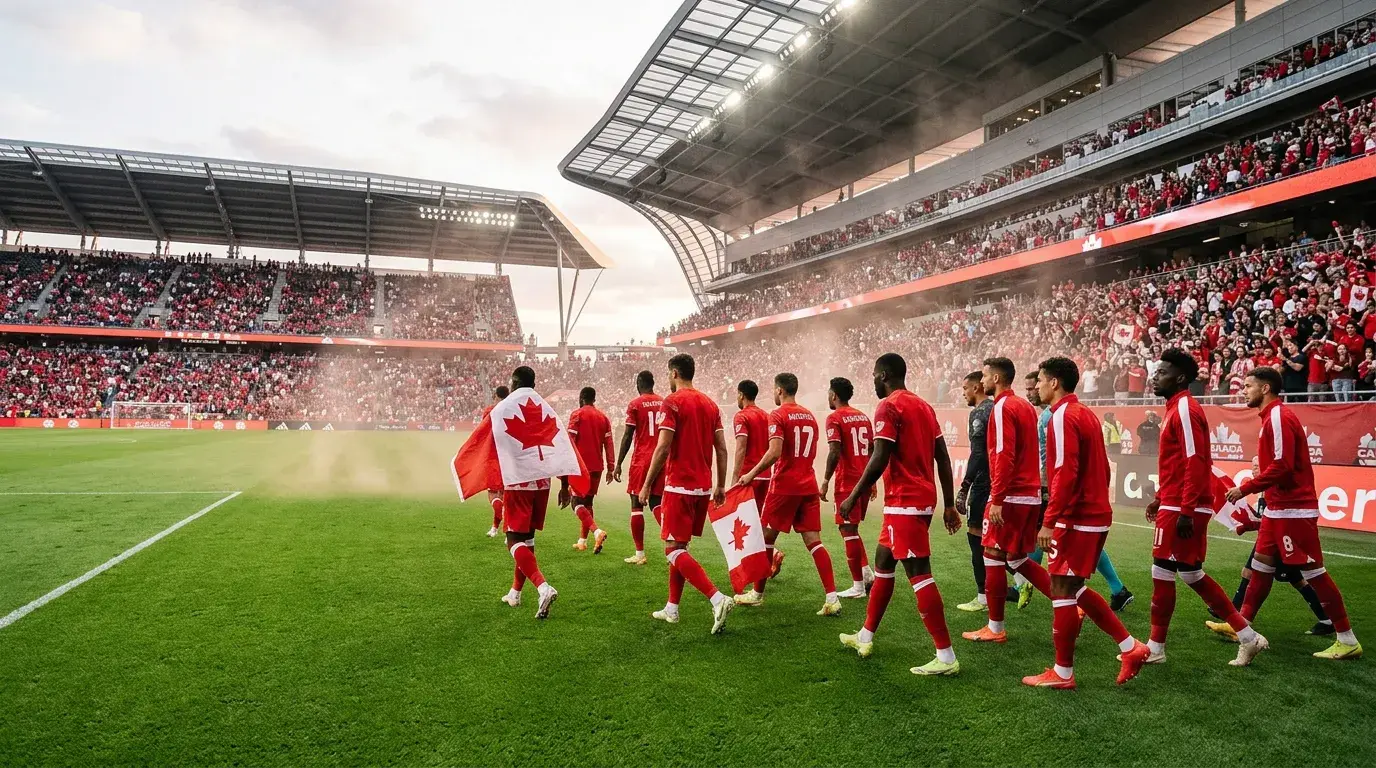
Canadian football has waited 36 years for this moment. The 1986 World Cup appearance — their only previous qualification without host status — represented isolated achievement that subsequent generations could not replicate despite enormous effort. World Cup 2026 arrives with Canada as co-hosts, providing opportunity to establish football’s legitimacy in a sporting landscape dominated by hockey, basketball, and lacrosse.
The transformation of Canadian football from CONCACAF afterthought to World Cup co-hosts reflects systematic investment that has produced the nation’s golden generation. Alphonso Davies, Jonathan David, and supporting talents represent quality that previous Canadian generations could only imagine. Whether this talent can translate to home tournament success determines Canadian football’s trajectory for decades following.
Canadian Squad Composition
Canadian squad construction features unprecedented European experience that separates this generation from predecessors dramatically. The number of players competing at elite continental levels establishes foundation for tournament competitiveness that domestic-only development through MLS and Canadian Premier League could not achieve.
Alphonso Davies leads Canadian football as global star whose Bayern Munich success validates ability at highest levels. His pace from left-back or wing creates attacking dimension that few defenders can contain through positioning alone — they simply cannot match his speed in transition. The transition from Vancouver Whitecaps to Bundesliga giant demonstrated development pathway that Canadian football now promotes aggressively to emerging talents.
Jonathan David provides goal-scoring threat from Lille that Ligue 1 statistics confirm repeatedly across multiple seasons. His movement, finishing, and link-up play creates central attacking presence that organised defences must respect with specific attention. At 26 during the tournament, David enters prime years where consistent productivity should peak if fitness allows full tournament participation.
Tajon Buchanan offers pace and directness from wide positions that Serie A experience at Inter Milan has refined beyond MLS development capabilities. His ability to beat defenders one-on-one and deliver quality crosses creates attacking dimension on the opposite flank from Davies. The combination of their pace creates symmetrical threat that defenders cannot simply load toward one side.
Cyle Larin provides alternative striking option whose Turkish and Belgian experience adds depth that single-option attacks cannot sustain across seven potential matches. His aerial ability and positioning creates different profile from David’s mobility, allowing tactical variation depending on opponent vulnerabilities.
Midfield options feature Stephen Eustáquio’s organisation, passing range, and competitive spirit alongside emerging talents whose European exposure has expanded. The balance between defensive responsibility and creative expression defines Canadian midfield selection debates that coaching staff must resolve through tournament progression.
Defensive organisation remains Canadian concern despite improvement from previous generations. Centre-back options lack the elite European experience that other positions feature prominently. This weakness could prove decisive against tournament opponents whose attacking quality exceeds CONCACAF standards significantly. Finding partnership that provides both aerial dominance and pace against quick forwards represents selection challenge.
Tactical Framework
Canadian football under current management emphasises attacking ambition that previous conservative approaches abandoned. The willingness to engage opponents rather than simply contain reflects personnel quality that defensive tactics would waste.
The system typically deploys 4-3-3 or 3-4-3 formations that maximise Davies’s attacking influence. His positioning varies between left-back and left-wing depending on opponent analysis and match situations. Building attacks through his side represents obvious priority that opponents must plan specifically to contain.
Pressing intensity has increased through European experience that players bring to international camps. Canadian teams now engage higher than previous generations’ conservative approaches permitted. The coordinated pressing that Davies and David lead generates turnover opportunities that quick transitions exploit.
Transition speed represents Canada’s primary weapon against organised opponents. The pace of Davies, Buchanan, and David in counterattacking situations creates threat that any defence must respect. Against possession-heavy opponents who commit numbers forward, Canadian transitions become particularly dangerous.
Set-piece organisation reflects preparation that tournament football rewards. Both defensive and attacking routines have improved beyond previous Canadian levels, though height disadvantages against some opponents require compensating positional discipline.
Group B Analysis
Canada’s Group B placement alongside Switzerland, Qatar, and Bosnia and Herzegovina presents manageable opposition that should facilitate knockout qualification. The group lacks heavyweight presence while containing teams capable of competitive performances.
Switzerland provides the toughest test based on consistent tournament pedigree and squad depth. Their defensive organisation and counterattacking quality has troubled major nations at recent tournaments. This fixture likely determines group leadership positioning that affects knockout bracket placement.
Qatar brings 2022 host experience that lacked competitive results — their group stage exit without victory suggests Canadian quality should prevail. The Al Annabi’s technical approach differs from CONCACAF opponents, requiring tactical adjustment.
Bosnia and Herzegovina’s qualification through UEFA represents quality that should produce competitive fixture. Their attacking talent and European tactical understanding creates specific challenges that Canadian preparation must address.
Home advantage benefits Canada throughout group stage, with matches in Canadian venues providing crowd support that neutral locations would not. The psychological boost from playing before home supporters could prove decisive in tight fixtures.
Canada World Cup 2026 Betting Assessment
Canada typically trades around 67.00-101.00 for tournament victory, positioning them among outsiders whose co-host status provides slight pricing reduction from typical Canadian expectations. The implied probability around 1-1.5% reflects realistic assessment of Canadian ceiling relative to established elite.
The value case involves home advantage combined with golden generation talent. Davies and David represent quality matching any tournament opponent’s key players. Playing before home crowds with supporter energy that hockey arenas demonstrate could elevate performances beyond objective quality assessment. The 1986 precedent — Canada’s only World Cup appearance — included home advantage that current co-hosting partially replicates.
The case against Canada centres on defensive vulnerabilities and tournament inexperience. The Qatar 2022 group stage exit — three losses without a point — demonstrated that attacking talent cannot compensate for structural weaknesses against elite opposition. Centre-back quality remains concern that home advantage cannot fully resolve.
Alternative markets offer potentially better value. Canada reaching quarter-finals prices around 5.00, reflecting hope that group stage navigation plus one knockout victory is achievable. Davies for tournament breakthrough moments offers value given his platform for performances that could define Canadian campaign.
For Australian punters, Canada represents co-host whose tournament success affects overall competition dynamics. Their results influence bracket positioning for multiple teams and provide context for assessing CONCACAF quality that extends to USA and Mexico evaluation.
Canadian World Cup Heritage
Canada’s World Cup history is brief but meaningful. The 1986 appearance — qualification achieved through CONCACAF — ended with group stage exit against France, Hungary, and Soviet Union without scoring a goal. That generation represented Canadian football’s first legitimate World Cup moment before 36 years of subsequent failure.
The Qatar 2022 appearance ended decades of frustration through qualification that announced Canadian football’s emergence. The group stage exit — losses to Belgium, Croatia, and Morocco — disappointed without surprising given opponent quality. Davies’s penalty miss against Belgium encapsulated a tournament where moments of quality could not overcome structural limitations.
The co-hosting role provides unprecedented platform for Canadian football development. Matches in Toronto and Vancouver will showcase Canadian football to domestic audiences whose engagement with the sport trails hockey, basketball, and even baseball significantly. Success at home could transform football’s position in Canadian sporting culture.
World Cup 2026 represents potentially defining moment for Canadian football. Home tournament success would establish football among mainstream Canadian sports; failure might suggest the sport’s ceiling in a crowded market. Davies, David, and this golden generation carry responsibility for determining football’s Canadian future beyond their individual careers.
