
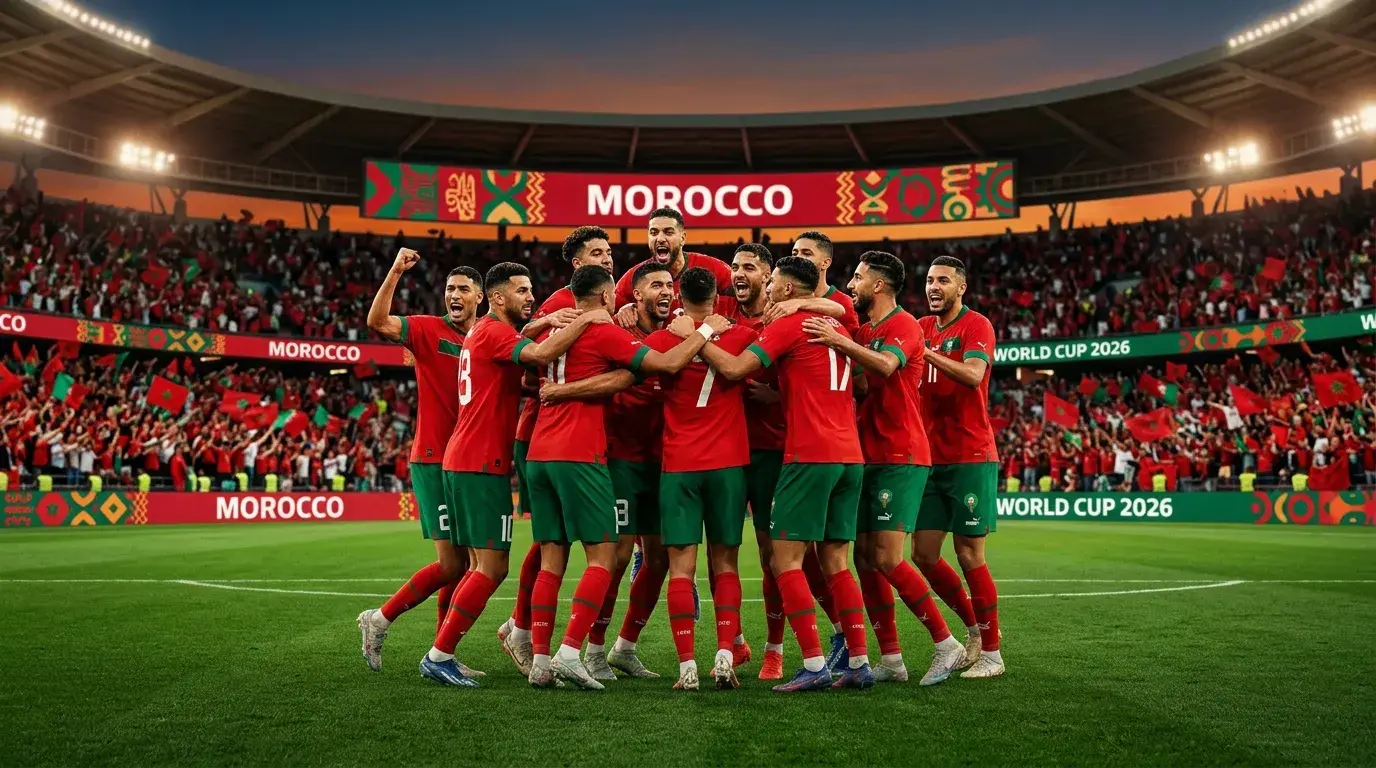
Moroccan football achieved the impossible at Qatar 2022. Becoming the first African and Arab nation to reach a World Cup semi-final, the Atlas Lions dismantled supposed betters — Belgium, Spain, Portugal — through defensive organisation and collective belief that surpassed individual talent limitations. World Cup 2026 arrives with expectations transformed by that historic run and pressure to prove it was no fluke.
The challenge Morocco faces involves transitioning from underdog magic to established contender. The defensive solidity that produced just one goal conceded in five matches cannot simply be replicated through personnel continuity. The collective spirit that elevated performance to unprecedented levels must be regenerated for different circumstances. Whether Morocco can sustain or surpass 2022’s achievement defines their 2026 narrative.
Moroccan Squad Analysis
Moroccan squad construction blends European experience across multiple leagues with African competitive rhythm that CAF qualification develops. The depth of European-based players exceeds most African nations significantly, creating tactical understanding that matches tournament requirements at elite level.
Achraf Hakimi anchors Moroccan defence from right-back with Paris Saint-Germain quality that few African nations possess in any position. His attacking threat from overlapping runs, pace in recovery when caught forward, and technical ability on the ball creates asymmetric advantages that tactical planning must account for. Building Moroccan attacks through his overlapping runs represents obvious strategic priority that opponents struggle to prevent without committing extra defensive resources.
Sofyan Amrabat provides midfield tenacity that 2022’s run demonstrated repeatedly against superior technical opponents. His ability to win duels, break up opposition attacks, and transition possession quickly anchors Moroccan organisation in ways that statistical analysis undervalues. The midfielder’s willingness to sacrifice individual expression for collective function defines Moroccan identity that produced 2022’s success.
Hakim Ziyech offers creative quality from Chelsea and Galatasaray experiences when fitness and form align appropriately. His delivery from set pieces creates aerial threat, his vision for final passes unlocks organised defences, and his goal threat from wide positions demands defensive attention. The inconsistency that has characterised his career represents both upside potential when everything clicks and downside risk when concentration wanders.
Yassine Bounou’s goalkeeping excellence proved decisive throughout 2022’s run. His penalty save heroics against Spain and shot-stopping consistency established him among tournament’s outstanding performers. Maintaining that form through 2026 provides defensive foundation that Moroccan tactical approach requires for success.
Azzedine Ounahi emerged during 2022 as midfield revelation whose ball-carrying and progressive passing exceeded expectations. His development since that tournament determines whether Morocco maintains midfield quality or relies too heavily on established names whose legs have accumulated further miles.
Defensive organisation depends on centre-back pairings whose European experience has developed beyond typical African levels. Nayef Aguerd and Romain Saïss — if fit — provide experience that tournament success requires, though their advancing ages create concerns about 90-minute durability across compressed schedules.
Tactical Foundations
Moroccan tactical identity emphasises defensive organisation that 2022’s success validated comprehensively. The willingness to absorb pressure, maintain shape, and wait for counterattacking opportunities reflects understanding of relative quality against elite opposition.
The system typically deploys 4-3-3 or 4-2-3-1 formations that balance defensive coverage with counterattacking presence. Hakimi’s advanced positioning from right-back creates numerical advantages in attacking situations while defensive midfield coverage maintains structural balance.
Pressing patterns reflect conservative approaches that prioritise shape over territory. Morocco typically engages in middle thirds rather than aggressive high pressing, preferring to funnel opponents into central areas where numerical advantages exist. This approach conserves energy while maintaining competitive intensity across 90 minutes.
Transition speed represents Morocco’s primary attacking weapon. Quick progressions from defensive positions into counterattacking situations exploit spaces that possession-heavy opponents necessarily leave. The pace on flanks and directness through central channels creates threat that any opponent must respect.
Set-piece organisation reflects investment that tournament football rewards. Ziyech’s delivery creates aerial threat that Moroccan height advantages can exploit. Defensive routines demonstrate discipline that has limited opponents’ scoring opportunities from dead-ball situations.
Group C Competition
Morocco’s Group C placement alongside Brazil, Scotland, and Haiti presents immediate challenge that tests whether 2022’s levels can be sustained against demanding opposition. Brazil’s inclusion creates fixture that showcases Moroccan ambition against South American elite whose technical quality exceeds any opponent from their historic 2022 run.
Brazil represents the defining group fixture whose result shapes tournament narrative for Morocco. The Seleção’s five World Cup titles establish pedigree that Belgium, Spain, and Portugal could not match despite their quality. Morocco’s ability to compete with elite nations was proven at 2022 — whether that capability extends to five-time champions determines group stage success. A positive result would announce Morocco’s 2022 run as beginning rather than peak; defeat would confirm the challenge ahead.
Scotland brings European organization and competitive intensity that Celtic and Rangers rivalry develops through weekly domestic pressure. Their direct approach and set-piece threat creates different challenge from Brazilian technical superiority that requires tactical adjustment. This fixture likely determines second-place positioning if Brazil wins the group as expected, making preparation crucial for knockout positioning.
Haiti’s qualification represents CONCACAF achievement that generates tournament enthusiasm throughout their squad and nation. Morocco should secure comfortable victory that establishes goal difference position and provides rotation opportunity for key players whose workload must be managed across potentially seven matches.
The knockout pathway presents potential round of 32 matchups against Group D opponents — potentially USA, Australia, Paraguay, or Turkey. Avoiding hosts USA in early rounds would benefit Moroccan progression hopes given the crowd advantage Americans would possess. The bracket positioning suggests quarter-final matchup against Group A or B winners could follow successful round of 32 navigation.
Morocco World Cup 2026 Betting Assessment
Morocco typically trades around 41.00-67.00 for tournament victory, significant improvement from pre-2022 pricing that reflected their historic run. The implied probability around 1.5-2.5% positions Morocco among credible outsiders whose deep progression represents realistic possibility rather than fantasy.
The value case involves proven tournament capability at elite level. Semi-final achievement at Qatar 2022 demonstrated that Moroccan organisation can overcome supposedly superior opponents when preparation and execution align. The core squad remains intact with accumulated experience that previous cycles lacked.
The case against Morocco centres on repeating exceptional performance. The 2022 run featured circumstances — underdog momentum, opponent complacency, individual heroics — that may not recur when opponents prepare specifically for Moroccan threats. Additionally, key players have aged without equivalent replacements emerging clearly.
Alternative markets offer potentially better value. Morocco reaching quarter-finals prices around 3.50, reflecting belief that knockout navigation is achievable while deep runs remain uncertain. Bounou for Golden Glove offers value if Moroccan defensive organisation replicates 2022 levels.
Moroccan World Cup Heritage
Morocco’s World Cup history features pioneering achievement followed by extended absence before modern resurgence. The 1986 group stage progression as first African nation to advance from World Cup group established continental precedent that subsequent generations sought to extend.
The Qatar 2022 semi-final represents transformative achievement that redefined Moroccan football’s global position. Victories over Belgium (2-0), Spain (penalties after 0-0), and Portugal (1-0) demonstrated capability that surprised global observers while confirming African football’s competitive trajectory. The semi-final loss to France (2-0) came against eventual finalists without disgrace.
The psychological impact of 2022’s run extends beyond Moroccan football to inspire continental ambition. African nations now approach World Cups believing that semi-final achievement is possible rather than fantasy. Morocco carries responsibility for demonstrating that 2022 represented sustainable development rather than isolated miracle.
World Cup 2026 provides opportunity to confirm Morocco among established tournament contenders or to suggest that 2022’s magic cannot be recaptured. The draw’s difficulty — Brazil in group stage — creates immediate examination that will clarify Moroccan trajectory. Success against the Seleção would announce Morocco’s arrival as permanent elite; failure might suggest 2022 represented peak rather than foundation.
