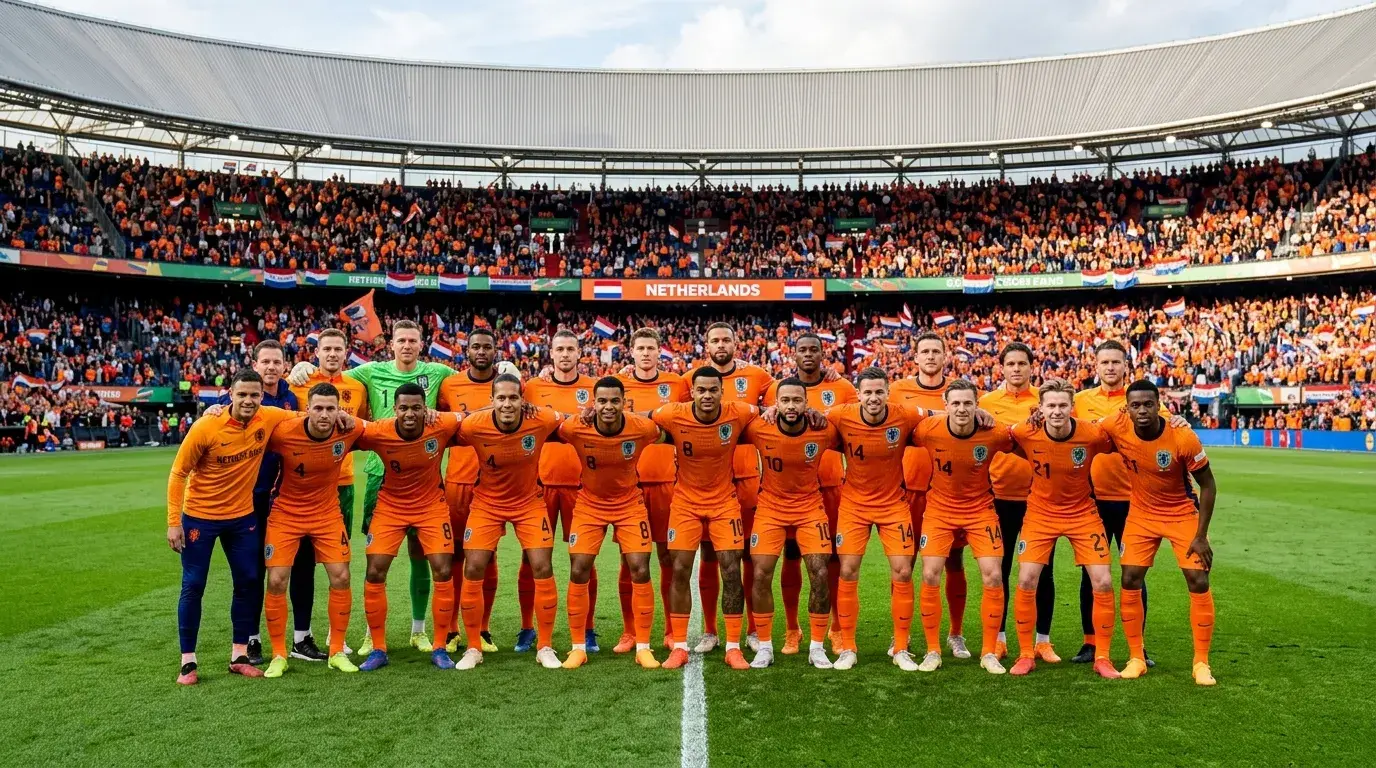
Three World Cup finals, zero victories. That painful statistic defines Dutch football’s relationship with the tournament that has delivered so much joy and heartbreak over decades. Netherlands at World Cup 2026 arrives with renewed optimism following Qatar 2022’s quarter-final appearance and a squad that blends emerging talents with established Eredivisie and European experience.
The Oranje’s tactical tradition — Total Football’s legacy — continues influencing Dutch approaches even as modern football demands different interpretations. Ronald Koeman’s second stint as national team manager has refined systems that balance possession principles with pragmatic tournament requirements. Whether this evolution produces the elusive World Cup title or another near-miss determines Dutch football’s immediate historical position.
Squad Analysis and Key Players
Dutch squad construction emphasises technical ability that flows from Eredivisie development through to European elite clubs. The conveyor belt of talent from Ajax, PSV, and Feyenoord academies continues producing players whose comfort on the ball exceeds most competitors at national team level. This development pathway ensures that even squad rotation maintains quality standards.
Virgil van Dijk anchors the defence with commanding presence that organises teammates through communication and positioning. His Liverpool experience competing at football’s highest level — Champions League finals, Premier League title races — translates directly to international contexts where similar pressure exists. At 34 during the tournament, Van Dijk’s physical capabilities remain sufficient for elite competition while his leadership value increases with accumulated experience. Building Dutch defensive identity around his presence represents obvious strategic choice that Koeman has embraced fully.
Frenkie de Jong provides midfield control that channels Dutch football’s historical traditions. His ability to receive under pressure, progress possession through dribbling, and distribute with both feet creates central platform for attacking play. The Barcelona midfielder’s understanding of positional play exceeds most international competitors, allowing Dutch possession patterns that frustrate opponents’ pressing attempts. His recovery from injury concerns that affected recent seasons will determine his tournament availability and effectiveness.
Cody Gakpo’s emergence has provided attacking threat that previous Dutch generations lacked. His direct running, finishing ability, and versatility across forward positions creates problems that organised defences struggle to solve. The Liverpool winger’s 2022 World Cup performances — three group stage goals that announced his arrival on the biggest stage — established big-tournament credentials that his club form has subsequently reinforced through consistent Premier League contributions.
Xavi Simons represents Dutch football’s exciting future. His development through PSG’s academy and subsequent loan experiences at PSV and RB Leipzig has produced a creative midfielder whose technical gifts suggest elite-level capability. At 22 during the tournament, Simons enters optimal development phase where talent meets competitive maturity. His playing style combines Dutch technical traditions with modern athletic demands.
Memphis Depay’s involvement depends on fitness and form. The former Manchester United and Barcelona forward provides experience and goal threat when available, yet injury concerns have limited his recent contributions. His ability to operate between lines and create from deeper positions adds tactical options if he arrives at the tournament healthy.
Defensive depth extends beyond Van Dijk through Nathan Aké’s versatility, Jurriën Timber’s emerging quality following his recovery from serious injury, and various full-back options including Denzel Dumfries’s attacking threat. Goalkeeper options feature Bart Verbruggen’s potential and experienced alternatives. The squad’s balance between positions suggests genuine tournament competitiveness rather than dependence on specific individuals whose absence would devastate prospects.
Koeman’s Tactical Approach
Ronald Koeman’s return to national team management brought tactical clarity that interim periods lacked. His experience from the first spell — which included Nations League success — provides foundation for tournament preparation that emphasises organisation over improvisation.
The system typically deploys 4-3-3 formations that honour Dutch traditions while incorporating defensive discipline that pure possession approaches sometimes neglect. Width comes from full-backs rather than fixed wingers, allowing central attackers positional flexibility that creates unpredictability. This fluidity within structure produces the balance that tournament football rewards.
Pressing patterns under Koeman reflect modern football’s demands without abandoning ball-retention principles. Netherlands engage high against weaker opponents while dropping into organised mid-blocks against stronger ones. This adaptability helps navigation across tournament phases where opposition quality varies significantly.
Build-up sequences involve goalkeeper and centre-backs prominently. Van Dijk’s passing range opens diagonal options that bypass midfield pressure, while De Jong’s movement creates receiving positions that progress possession effectively. The patience required for this approach sometimes frustrates supporters seeking directness, yet results justify the process.
Set pieces receive significant preparation under Koeman’s regime. Dutch height advantage — Van Dijk, De Ligt, Aké — creates aerial threat from corners that opponents must respect. Free kick routines feature varied delivery options that generate genuine goal probability from wide areas.
Group F Draw Assessment
Netherlands’ Group F placement alongside Japan, Tunisia, and Sweden presents competitive opposition that demands respect without creating genuine threat to Dutch qualification. Japan’s 2022 World Cup victories over Germany and Spain demonstrate their capability, while Tunisia and Sweden offer different challenges.
Japan represents the marquee group fixture following their shock group stage victories at Qatar 2022. The Blue Samurai’s organisation, counterattacking speed, and technical ability create genuine challenge that complacent opponents have learned to respect. Netherlands cannot afford the concentration lapses that Japan punished against Germany. This fixture likely determines group leadership and subsequent bracket positioning.
Tunisia brings African football’s defensive organisation and competitive spirit. Their 2022 World Cup draw against Denmark and victory over France’s reserves demonstrated ability to frustrate superior opponents. Netherlands must break down organised defences that Tunisia will present while avoiding counterattacking vulnerability.
Sweden’s qualification marks return to World Cup football with a squad featuring Bundesliga and Premier League players. Their physical approach and set-piece threat creates different challenge from technical Asian or African opponents. Netherlands should progress comfortably but cannot assume dominance.
The knockout pathway presents potential round of 32 matchups against Group E opponents — likely Germany, Ecuador, or Ivory Coast. The Germany possibility creates immediate rivalry intensity that transcends typical early knockout rounds. Dutch victories over Germany at major tournaments carry historical weight that affects player mentality regardless of current form.
Netherlands World Cup 2026 Betting Markets
Netherlands typically trades around 15.00-21.00 for tournament victory, positioning them among the second tier of contenders behind established elite teams. This pricing reflects squad quality and tactical coherence while acknowledging the historical pattern of World Cup near-misses that has defined Dutch tournament football across generations.
The value case involves squad balance that exceeds many competitors. Netherlands possesses quality across all positions without obvious weakness that opponents can target and exploit systematically. The blend of Premier League experience (Van Dijk, Gakpo, Aké) with continental expertise (De Jong, Simons) creates tactical flexibility that adapts to different opposition profiles. Koeman’s tournament management experience — including Euro 2020 progress before his departure to Barcelona — suggests competent navigation through knockout pressures that less experienced managers struggle with.
The draw pathway provides additional optimism. Group F opponents — Japan, Tunisia, Sweden — present challenges without being insurmountable. Early knockout rounds against Group E opponents could feature Germany, but also might produce more manageable opposition depending on group results. This bracket positioning suggests quarter-final achievement is realistic expectation.
The case against Netherlands centres on persistent finals failure that creates psychological burden. Three World Cup finals lost — 1974, 1978, 2010 — establishes pattern that current players inherit even without personal involvement in those defeats. The pressure of potentially ending this drought creates burden that talented squads have failed to overcome repeatedly. Additionally, the squad lacks genuine world-class attackers beyond Gakpo whose tournament credentials, while promising from 2022, remain limited to a single competition.
Alternative markets present opportunities for more granular positioning. Netherlands reaching semi-finals prices around 4.00, reflecting belief that knockout navigation is achievable while title contention remains uncertain. Gakpo for tournament top scorer offers longer odds that could represent value if he replicates 2022 group stage form across expanded tournament. Team totals during group stage depend significantly on opponent approach — Japan’s counterattacking could produce goals in both directions while Tunisia might produce low-scoring contest.
For Australian punters, Netherlands represents a team whose tournament position unlikely intersects with Australian interests directly given bracket separation. However, understanding Dutch strengths informs betting on potential knockout opponents and overall tournament dynamics when Dutch results affect pricing elsewhere.
Dutch World Cup History and Legacy
Netherlands’ World Cup history features moments of brilliance alongside devastating disappointments that have shaped national football identity. The 1974 and 1978 squads played football that revolutionised the sport while losing consecutive finals to host nations — West Germany and Argentina respectively. The 2010 squad reached another final before Spain’s Iniesta delivered extra-time heartbreak that continued the pattern of painful near-misses.
Total Football’s legacy — the tactical innovation that 1970s Dutch teams pioneered — continues influencing football globally while Netherlands have not won the tournament their philosophy helped shape. Johan Cruyff, Johan Neeskens, and their contemporaries created approaches emphasising positional interchange, pressing, and technical excellence that produced beauty without ultimate success. The irony of inventing modern football while failing to win its greatest prize haunts Dutch football.
The 1988 European Championship triumph remains Netherlands’ only major international trophy. That squad — Van Basten, Gullit, Rijkaard — demonstrated Dutch ability to win knockout tournaments when circumstances aligned. The World Cup’s specific pressure has proven different, with finals producing heartbreak that European success could not replicate.
Modern Dutch football has oscillated between tournament success and qualification failure. Missing Euro 2016 and World Cup 2018 represented low points that questioned whether Dutch football development had stalled relative to European competitors. Subsequent Nations League victory in 2019 and tournament returns suggest recovery, though World Cup success remains elusive.
The 2022 World Cup quarter-final exit to Argentina — on penalties after a dramatic 2-2 draw that saw Netherlands rally from two goals down — encapsulated Dutch tournament experience. Brilliant fightback followed by shootout heartbreak produced another “what if” chapter in a history filled with them. Weghorst’s late goals suggested destiny might finally favour Dutch football before familiar penalty demons returned.
World Cup 2026 provides opportunity to finally convert potential into achievement, or to add another painful near-miss to the collection. The current squad possesses quality comparable to previous generations that reached finals. Whether psychological barriers that have prevented Dutch World Cup victory can finally be overcome determines the legacy this generation establishes.
