

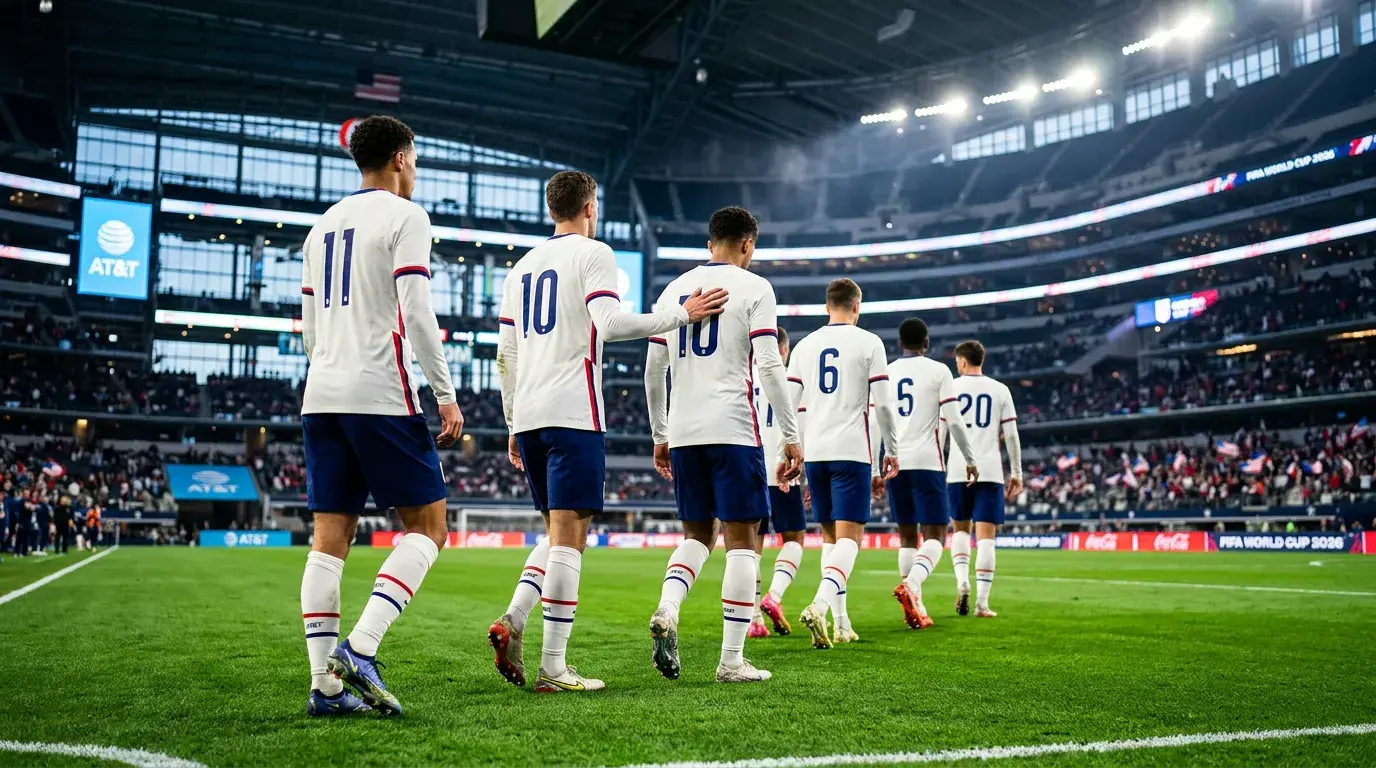
Host nation advantage is not merely psychological — it shapes every tactical consideration, every recovery session, and every crowd interaction across 39 tournament days. USA at World Cup 2026 arrives with expectations that no American generation has previously shouldered. The country that brought professional soccer into mainstream sports consciousness now demands results that match investment levels exceeding any previous era.
The USMNT enters Group D as heavy favourites, yet the squad’s composition reveals vulnerabilities that opponents will exploit. Christian Pulisic remains the talisman whose fitness determines attacking output. Weston McKennie provides midfield steel that can disappear during flat performances. Tyler Adams marshals the engine room with intelligence that occasionally overthinks simple situations. These players have accumulated significant international experience, including a round of 16 appearance at Qatar 2022 and subsequent Gold Cup success, but hosting pressure creates unique psychological burdens.
For Australian punters, understanding USA World Cup 2026 dynamics extends beyond simple opposition analysis. This is the team that faces the Socceroos in Seattle on 20 June — a fixture that could determine Group D standings and knockout round prospects for both nations. Getting this assessment right matters more than academic curiosity about American soccer.
What Playing at Home Really Means for American Chances
When South Korea reached the 2002 semi-finals on home soil, sceptics pointed to officiating controversies. When Russia topped their group in 2018, analysts credited favourable draws. But host nation success transcends luck or bias — it reflects genuine competitive advantages that accumulate across multiple factors, many invisible to casual observers.
The most measurable advantage involves travel elimination. While European and South American squads adjust to Pacific time zones, altitude variations in Mexico City, and climate differences across 16 venues, USA players remain in familiar environments. The national team training facility in Carson, California sits within driving distance of three tournament stadiums. Players sleep in their own beds between matches when logistics permit. This accumulated rest advantage compounds across group stages and knockout rounds.
Crowd influence extends beyond mere noise generation. American soccer culture has evolved dramatically since 1994, with supporter groups now matching European intensity levels in major venues. Seattle’s Lumen Field — where USA faces Australia — averages over 68,000 attendance for Sounders matches, creating an atmosphere that visiting teams find genuinely hostile. That pressure increases exponentially when national pride intersects with World Cup stakes.
Historical data supports home nation optimism without guaranteeing success. Of 22 World Cup tournaments, the host nation has reached at least the quarter-finals on 17 occasions. Only South Africa in 2010 failed to escape the group stage among hosts with genuine preparation time. USA should progress from Group D — the question involves how deep their run extends and whether they can justify odds that price them among genuine contenders.
The shadow side of hosting involves expectation pressure that can paralyse young squads. USA crashed out of the 2022 round of 16 against Netherlands despite controlling possession, unable to convert dominance into goals when the tournament’s intensity peaked. That psychological barrier remains unbroken. Home support might amplify pressure rather than alleviating it, particularly if early tournament performances underwhelm.
Breaking Down the American Squad Heading to Their Home World Cup
Gregg Berhalter’s selection pool represents the most talented American generation in history, yet questions persist about tournament readiness. European experience permeates the roster — over 20 regular call-ups play in the top five leagues — but converting club form into international success requires different skills than Premier League or Bundesliga campaigns.
Christian Pulisic anchors the attack from a nominal left-wing position that frequently drifts centrally. His 2022-23 season at AC Milan produced 15 goals and 9 assists across all competitions, demonstrating that Champions League level finishing exists in his locker. The concern involves injury history — Pulisic has missed significant periods in four consecutive seasons, raising availability questions that betting markets must price. When fit and confident, he transforms USA’s attacking capability. When absent or struggling, the team lacks creativity to unlock organised defences.
The midfield triangle determines American control patterns. Tyler Adams operates as the deepest midfielder, recycling possession and initiating pressing triggers. His reading of opposition transitions provides defensive coverage that allows full-backs attacking freedom. Weston McKennie surges forward from a box-to-box role, providing aerial presence and goal threat that other American midfielders lack. The third position rotates between Gio Reyna, whose technique suggests generational talent when confidence peaks, and Yunus Musah, whose athleticism offers different matchup possibilities.
Centre-forward options have expanded beyond initial expectations. Ricardo Pepi’s emergence at PSV Eindhoven yielded 17 league goals during the 2024-25 season, establishing him as primary number nine. His movement creates space for wide players, though physical duels against elite centre-backs remain a development area. Folarin Balogun provides alternative — pace and directness that Pepi sometimes lacks, but with reduced hold-up ability. Berhalter will likely deploy different options depending on opposition defensive profiles.
The defensive unit carries concerns that bookmakers may underweight. Sergiño Dest’s attacking instincts from right-back create offensive overloads but expose spaces behind him. His time at Barcelona and PSV developed technical ability that allows participation in build-up play, yet defensive recovery remains inconsistent when caught upfield. Antonee Robinson provides similar profile from the left, generating crosses but requiring midfield cover. His athleticism compensates for positioning errors, though elite opposition will exploit the gaps his forward runs create.
Centre-back pairing between Chris Richards, Tim Ream, and Cameron Carter-Vickers offers experience without elite pace — high defensive lines against quick opponents present risk. Richards’ Crystal Palace experience provides Premier League physicality, while Ream’s veteran presence adds composure during pressure moments. Celtic defender Carter-Vickers brings aerial strength that becomes crucial against teams attacking set pieces. The rotation between these three depends on opposition profiles — pacier forwards demand different partnerships than aerial threats.
Goalkeeper Matt Turner has accumulated Arsenal experience, though limited Premier League minutes create questions about match sharpness. His shot-stopping ability rates highly among American keepers across generations, with reflexes that produce highlight-reel saves. The concern involves distribution under pressure — building from the back against aggressive pressing teams requires confidence on the ball that Turner has not consistently demonstrated. Backup options Zack Steffen and Sean Johnson provide depth without inspiring confidence that the position is truly secure.
How Berhalter Sets Up His Teams for Major Tournaments
Gregg Berhalter’s tactical identity has evolved since his appointment in 2018, though possession-based principles remain central. His system emphasises building from the back, numerical advantages in midfield, and wide overloads that stretch opposition defensive structures. Critics argue this approach lacks directness and fails to utilise USA’s counterattacking potential, particularly Pulisic’s ability to run at defenders.
The typical shape deploys a 4-3-3 in possession that morphs into a 4-2-3-1 or 4-4-2 defensive structure depending on opposition profiles. Full-backs push high, often beyond the wingers, requiring central midfielders to provide covering balance. This creates passing triangles across the pitch but demands precise positional discipline — breakdowns in structure leave USA vulnerable to direct counterattacks.
Pressing intensity varies according to match context rather than maintaining consistent high energy. USA typically starts aggressively, hunting early goals before retreating into a mid-block that conserves energy for later stages. This approach suits knockout football where extra time possibilities exist but can frustrate during group stage matches where clinical finishing would end games earlier.
Set pieces represent an area of genuine strength. USA scored six goals from dead-ball situations during 2024 fixtures, exploiting aerial advantages that exist throughout the squad. Opponents cannot afford soft fouls around the box — American delivery quality and attacking movement create genuine goal probability from every free kick and corner.
The question for 2026 involves whether Berhalter adapts his approach to home tournament circumstances. Possession dominance against Paraguay and Turkey seems achievable, but does controlling the ball translate to controlling matches? Australia will sit deep and counterattack, requiring USA to break down low blocks rather than exploit transition opportunities. Berhalter’s success depends on tactical flexibility that has not always been evident.
Group D From the American Perspective
USA’s draw could have been considerably worse. Avoiding Group C with Brazil, Morocco, and Scotland eliminates early tournament complications against genuine contenders. Group D presents manageable opponents that still demand respect — Paraguay’s compact defence, Turkey’s technical quality, and Australia’s tournament experience all create potential banana skins.
The opening fixture against an undisclosed opponent determines tournament trajectory. USA tends toward slow starts in major competitions — the 1-1 Wales draw at Qatar 2022 reflected nerves that needed settling. If the tournament opener produces victory by two or more goals, confidence flows through the squad. If it yields unexpected difficulty, pressure mounts before the crucial middle fixtures.
Paraguay represents unfamiliar opposition for American players more accustomed to CONCACAF and European opponents. South American tactical intelligence involves game management techniques — slowing pace, winning fouls in dangerous areas, and exploiting set piece opportunities — that can frustrate possession-oriented teams. USA must convert early dominance into goals before Paraguay settles into defensive rhythm.
Turkey arrives with European experience from recent Euros and a squad that blends youth with tournament knowledge. The matchup against American pressing intensity becomes fascinating — will Turkey’s technical ability in tight spaces find solutions, or will American athleticism dominate central areas? This fixture likely determines group leadership.
Australia at Lumen Field carries specific significance for Seattle’s 68,000 supporters. The Socceroos will compete physically, defend compactly, and hunt counterattacking opportunities. USA cannot underestimate an opponent that reached the 2022 knockout rounds and possesses genuine pace through Irankunda. Three points remain the expectation, but margin matters for goal difference calculations.
Understanding USA Betting Odds for World Cup 2026
USA odds to win World Cup 2026 typically fall around 12.00, positioning them as seventh or eighth favourites depending on market fluctuations. This pricing implies approximately 8% probability of lifting the trophy — significantly higher than historical baseline for host nations but reflecting the squad’s genuine quality rather than purely home advantage.
The challenge for punters involves parsing host nation premium from actual competitive probability. Historical World Cup data shows hosts outperform market expectations by roughly 15-20% on average. If USA’s “true” odds would be 18.00 without hosting, the 12.00 price reflects appropriate adjustment. If their underlying probability is lower, current odds may offer poor value despite superficial appeal.
To reach the quarter-finals, USA most likely faces a Group C runner-up in the round of 32 (potentially Morocco or Scotland), followed by a Group A or B opponent. This pathway appears manageable compared to brackets containing Brazil, France, or Argentina in early knockout rounds. Quarter-final odds around 3.50 offer reasonable value given this draw consideration.
Group D betting markets tell their own story. USA at 1.80 to top the group carries implicit probability around 56% — substantial but not overwhelming favouritism. Turkey at 4.00 suggests roughly 25% probability, with Paraguay and Australia splitting remaining market share. For Australian punters seeking to oppose USA, tournament opener nervousness creates the window for upsets before confidence builds.
Match-specific markets will develop closer to kick-off, but preliminary pricing suggests USA around 1.45 for victory against Australia with draw around 4.20 and Australian victory near 7.00. These lines reflect home advantage, squad quality differential, and crowd factors. Whether they accurately price Australian defensive resilience under Popovic remains debatable.
USA vs Australia Preview — The Seattle Showdown
The 20 June fixture at Lumen Field represents the most anticipated Group D match from Australian perspective and a fixture USA must win to maintain tournament momentum. Both nations carry sufficient quality and motivation to make this genuinely competitive despite odds suggesting American dominance.
USA’s approach will prioritise early pressure designed to unsettle Australian confidence before defensive organisation solidifies. Expect Berhalter’s pressing triggers to engage immediately, forcing turnover opportunities in dangerous areas. If Australia withstands the opening 15 minutes without conceding, the match dynamics shift toward a more open contest.
Australian strategy involves absorbing pressure, maintaining defensive shape, and exploiting counterattacking moments through Irankunda’s pace. The Socceroos will not seek possession dominance — that battle is unwinnable against American technical quality. Instead, Popovic will emphasise defensive discipline, set piece competitiveness, and clinical finishing from limited opportunities.
Key individual battles determine outcomes. Pulisic versus Australia’s right-back (likely Atkinson) becomes the primary attacking duel — can Australian defenders contain his dribbling and movement without fouling in dangerous areas? Jackson Irvine against Weston McKennie in central midfield pits experience against athleticism. Mat Ryan versus Ricardo Pepi in one-on-one situations may decide the match.
The crowd factor cannot be overstated. Seattle supporters create hostile environments that visiting teams find genuinely uncomfortable. Early kickoff (5am AEST) means minimal Australian travelling support — the noise will be overwhelmingly one-directional. Mental preparation for this atmosphere determines whether Australian players perform to capability or shrink from occasion.
My assessment prices this fixture closer to 55-25-20 in USA’s favour rather than the 65-20-15 markets suggest. Australia’s defensive record under Popovic and tournament experience provides more protection than odds imply. A speculative punt on Australia double chance at 2.75 offers value if you believe the Socceroos can compete for 90 minutes.
American World Cup History and What It Means for 2026
USA’s World Cup pedigree extends further than casual observers recognise. The 1930 tournament in Uruguay featured an American squad that reached the semi-finals — a result that has never been repeated. Bert Patenaude scored the first hat-trick in World Cup history during that campaign, a piece of trivia that surprises those who view American soccer as a recent development. Since modern qualification structures emerged, USA has appeared in 10 World Cups with varying success levels that provide context for 2026 expectations.
The 1994 home World Cup established benchmarks for 2026 expectations. That squad advanced from the group stage despite facing Switzerland, Colombia, and Romania. The round of 16 match against eventual champions Brazil required extra time to separate the teams, with Brazil’s Bebeto scoring the decisive goal. The tournament’s commercial success transformed American soccer infrastructure, creating the professional leagues and academies that produced current players. 2026 arrives as the payoff for 30 years of investment.
Recent World Cup performances establish both promise and concern. Germany 2014 saw USA advance from a group containing Germany, Portugal, and Ghana — credible progress before Belgium’s extra-time victory ended the run. Romelu Lukaku’s introduction changed that match entirely, exposing American defensive vulnerabilities against elite substitutions. Russia 2018’s absence following qualification failure to Trinidad and Tobago remains traumatic. That 2-1 defeat in Couva represented the lowest point in modern American soccer history and motivated wholesale programme changes.
Qatar 2022’s round of 16 exit to Netherlands demonstrated competitiveness without breakthrough. The 3-1 scoreline suggested comfortable Dutch progress, but American possession dominance created multiple opportunities that superior finishing would have converted. Memphis Depay’s opener exposed defensive momentary lapses that cannot occur against elite opposition. The tournament confirmed the generation’s talent while highlighting the gap between competing and advancing deep.
The pattern reveals a team that consistently reaches knockout rounds without advancing deep into tournaments. Breaking this ceiling requires either exceptional individual performances or tactical innovation that previous American squads lacked. The 2026 generation possesses the talent — whether they possess the mentality remains unproven.
My Tournament Forecast for the Americans
USA will advance from Group D as winners or runners-up — this much seems certain barring catastrophic circumstances. Seven points from three matches represents my base expectation, with victories against Australia and Paraguay sandwiching a potential draw against Turkey. Group stage navigation should prove straightforward despite nervousness that accompanies home tournament pressure.
The round of 32 presents an examination against a Group C opponent — likely Morocco or Scotland if Brazil tops that group. USA should progress, though Morocco’s 2022 semi-final run demonstrates African football’s current trajectory. The Atlas Lions’ defensive discipline and counterattacking threat represents exactly the type of opponent that has troubled American squads historically. Quarter-final positioning remains the realistic ceiling for objective assessment, though this round is where genuine tests begin.
Should USA reach the quarter-finals, opponents from Groups A or B await — potentially Mexico, Switzerland, or a surprise package from a group containing Canada. These fixtures would be played on American soil against opponents with their own regional support bases. The Mexico possibility creates particularly fascinating dynamics — a World Cup quarter-final between neighbouring nations with decades of rivalry history.
My forecast places USA among the final eight teams with approximately 55% probability. Their most likely exit point arrives in the quarter-finals against a superior South American or European opponent — potentially Colombia, France, or Portugal depending on bracket developments. Semi-final or beyond requires results going their way and American players exceeding previous tournament ceilings.
The betting angle involves quarter-final progression at 3.50, which I rate as fair value given draw benefits. USA offers less value at current outright prices — their probability of winning the tournament falls closer to 5% than the implied 8%, though home advantage creates genuine uncertainty. For Australian punters specifically, understanding USA’s strengths and weaknesses informs both Group D betting and potential knockout round predictions. The Americans represent formidable but beatable opposition when approached with proper tactical discipline.
