
England Bronze Medal World Cup 2026: Best Finish Since 1966
 Available in US
Loading...
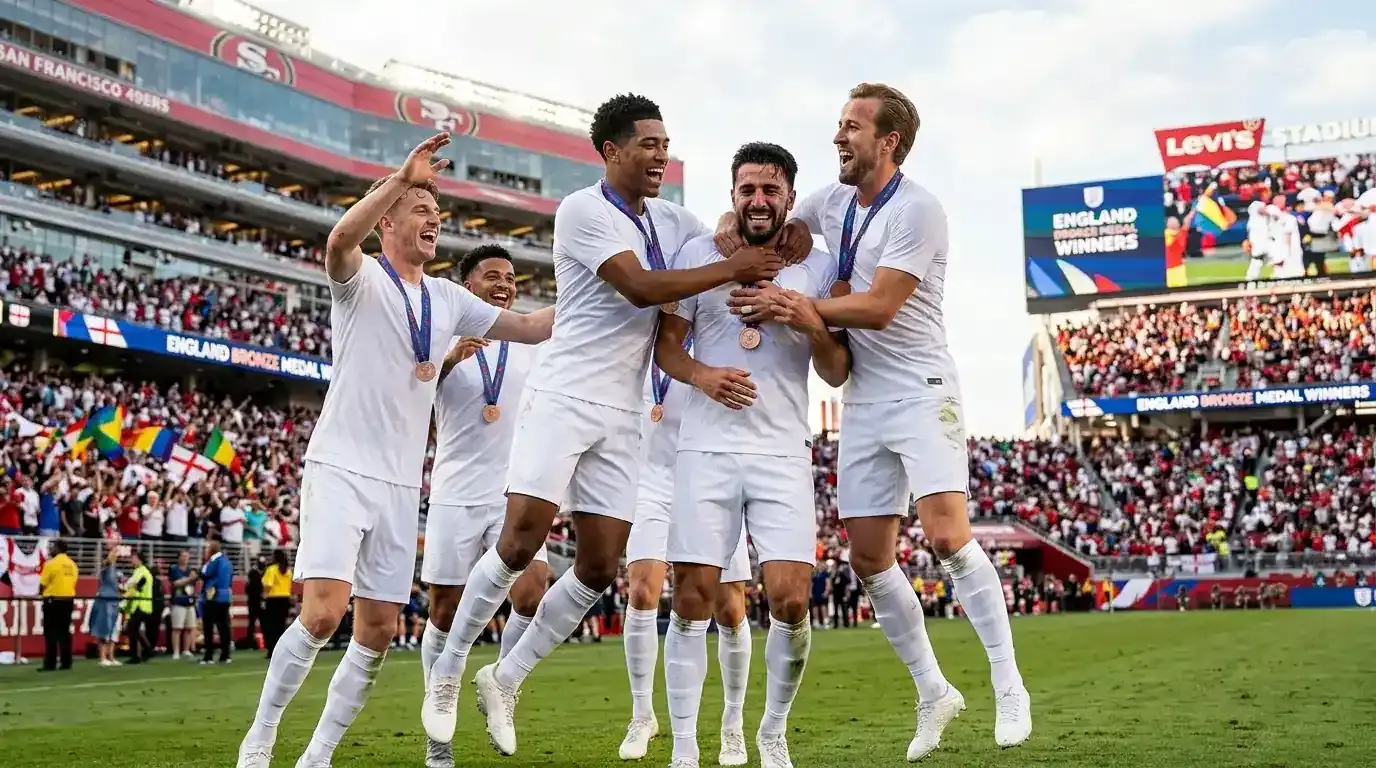
England have secured third place at the 2026 FIFA World Cup, beating France 6-4 in the bronze medal match on 18 July. It is England’s best World Cup finish since they won the tournament as hosts in 1966 — a 60-year wait for a podium place, finally ended on the far side of the Atlantic at the first 48-team World Cup, staged across the United States, Canada and Mexico.
The 10-Goal Thriller
The bronze medal match delivered the highest-scoring game of the entire tournament and the most goals seen in a single World Cup match since 1982. England came out on top of a wild, open contest that finished 6-4 — ten goals in one knockout tie, in a stage of the competition that usually turns cautious and low-scoring.
That scoreline tells you almost everything about the character of the match. The bronze final is a fixture both teams reach after the emotional gut-punch of a semi-final defeat, and it is often a flat, going-through-the-motions affair. This was the opposite. Both sides attacked, both sides were repeatedly exposed at the back, and the goals kept coming until the final whistle. For the neutral — and for anyone who had backed goals — it was the game of the tournament’s closing weekend.
The 10 combined goals stand as the tournament’s single-match high. No other fixture across the 104 matches of World Cup 2026 came close, which is part of why the result has been so widely discussed since the final whistle: a third-place play-off rarely produces the most memorable ninety minutes of a World Cup, but this one did.
For Australian audiences, the bronze final landed on a Saturday afternoon body-clock window that made it one of the more watchable fixtures of the tournament’s back end — a genuine reason to stay tuned rather than a match to skip. The North American host time zones meant most of the knockout rounds unfolded through the small hours of AEST, and by the third-place play-off many Aussie viewers had already settled into the pattern of catching results the morning after. A ten-goal thriller was a reward for those who did tune in live, and a talking point for everyone who caught up on the highlights over breakfast.
It is also worth setting the match in the wider frame of the tournament it closed. World Cup 2026 was the first 48-team edition, expanded from 32, and the first spread across three host nations — the United States, Canada and Mexico — over 104 matches from 11 June to 19 July. A longer, larger tournament raises the stakes on late-stage fatigue and squad depth, and a bronze final that produces ten goals is, in part, a story about two tired teams whose attacking instincts outran their defensive discipline at the very end of a gruelling six-week campaign.
Saka’s Hat-Trick Heroics
Bukayo Saka was the standout performer, scoring a hat-trick to lead England’s charge. His three goals drove England’s attack and settled the destination of the bronze medal, and they took him to seven goals for the tournament overall.
Seven goals put Saka level with his England team-mate Jude Bellingham in the tournament scoring charts — two England players sharing seven each is a marker of how much of the side’s threat came from that pairing. The hat-trick itself was the highlight of Saka’s campaign and the kind of decisive individual performance England had been waiting for from him on the biggest stage.
For a winger who has carried the weight of past tournament heartbreak with England, a World Cup hat-trick in a match this open is a significant moment — the sort of performance that reframes how a player is remembered at a major tournament, regardless of the colour of the medal.
There is a broader point in the way England’s goals were shared. With Saka and Bellingham finishing level on seven each and Kane on six, England’s threat was not funnelled through a single figure but spread across the front line. For a side that has historically leaned heavily on one talismanic scorer, a more distributed goal load is a meaningful shift — it makes a team harder to plan against and less dependent on any one player finding form on the day. Over a long tournament, that kind of shared burden is often what separates the sides that reach the final four from those that bow out earlier.
From an Australian following-along perspective, Saka’s afternoon was exactly the sort of individual story that travels well. Aussie football coverage tends to latch onto clear narratives — a redemption arc, a breakout hat-trick, a marquee name delivering when it counts — and Saka’s three goals gave the local highlight packages and match reports their headline. It is the kind of moment that keeps a neutral audience invested in a tournament even once their own nation’s interest has faded.
England’s Tournament Run
England reached the bronze match the hard way. Their run ended in the semi-finals, where they lost 2-1 to Argentina on 15 July — the eventual runners-up, and a side that won seven matches on the spin before falling in the final itself.
That semi-final defeat sent England into the third-place play-off against France, who had lost their own semi-final 2-0 to Spain on 14 July. Two beaten semi-finalists, both stinging from narrow-to-comprehensive defeats, met in a bronze final that then produced the highest-scoring match of the whole competition.
Finishing third means England were, on the evidence of the final standings, the best of the rest behind the two finalists. Spain took the title, Argentina were runners-up, and England edged France for the bronze. In a 48-team field, reaching the final four and then winning the play-off is a genuinely strong return — even if, for a nation with England’s history and expectations, the semi-final defeat will be the part that lingers.
Historic Context: A 60-Year Wait Ends
England’s third-place finish is their first World Cup podium since 1966 — the year they won the tournament on home soil. Six decades on, a bronze medal is not the trophy the country has spent generations chasing, but it is the first tangible podium finish in all that time, and that context is exactly why the result matters.
Between 1966 and 2026, England repeatedly arrived at World Cups among the contenders and repeatedly fell short of a podium. A semi-final or a quarter-final, however creditable, does not put a medal round the players’ necks. This time they crossed that line. The 6-4 win won’t rewrite the disappointment of the semi-final against Argentina, but it does end the longest podium drought in the modern history of one of the sport’s founding nations.
For Australian fans following along in the small hours on AEST, England’s runs are a familiar story — a heavyweight who promises and rarely delivers the ultimate prize. Third place is progress on that narrative, and it re-establishes England as a side to take seriously in outright markets at the next World Cup.
France’s Disappointment: Deschamps’ Final Match
For France, the 6-4 defeat capped a tournament that began with genuine title aspirations and ended in fourth place. Conceding six goals in the bronze match underlined the defensive problems that had already shown in the semi-final loss to Spain, and in the end it was those lapses — not a lack of attacking quality — that kept France off the podium.
The match also marked the end of an era. It was Didier Deschamps’ final game as France manager, closing a 14-year spell in charge — one that included the 2018 World Cup title and the 2022 final. Ending that tenure with a fourth-place finish and a six-goal concession is a subdued farewell for one of the most successful managers in French football history. Zinedine Zidane is the widely expected successor, though the transition frames France’s 2026 as the close of a chapter rather than the start of a decline.
France’s attacking talent was never in doubt across the tournament — the problem in the bronze final, and arguably in the semi-final, was at the other end. That is the puzzle Deschamps’ successor inherits.
Golden Boot: Mbappé’s Individual Landmark in a Fourth-Place Finish
The bronze match had a decisive say in the tournament’s individual honours. Kylian Mbappé’s contribution against England took his tournament tally to 10 goals and secured the Golden Boot — the top-scorer award — ahead of Argentina’s Lionel Messi on eight.
It made Mbappé the first player ever to win the World Cup Golden Boot at two different tournaments, back-to-back. He also set a new all-time World Cup goals record across his career. Yet all of it came in a fourth-place campaign — the clearest example at this World Cup of a brilliant individual return sitting inside a disappointing team result. France’s best player finished the tournament with the Golden Boot and a set of records, and without a medal.
Behind Mbappé, the scoring charts were led by the finalists and by England’s front line: Bellingham and Saka on seven each for England, Kane on six, and France’s Ousmane Dembélé also on six. The spread shows how much of the tournament’s goals came from its deepest-running sides.
What It Means for England
Third place gives England something to build on. Reaching the final four of a 48-team World Cup, and then winning the play-off in the highest-scoring match of the tournament, is a strong platform — the kind of run that a squad can carry forward as hard-won big-tournament experience.
The honest read is that this is progress rather than arrival. England still have not won a major tournament since 1966, and a bronze medal does not change that headline. But finishing above France, and finishing as the best team outside the two finalists, is a firmer footing than a quarter-final exit — and it re-establishes England near the front of the queue whenever the next outright markets open.
For Aussie Punters
From an Australian betting perspective, the takeaway from England’s campaign is less about this bronze result — already settled — and more about what it signals for future markets. A side that reaches a World Cup semi-final and wins its play-off is one bookmakers will keep pricing among the contenders, and England’s habit of promising deep runs makes them a recurring feature of long-range outright books.
The bronze final itself was a reminder that knockout football does not always follow the low-scoring script the markets expect. A third-place play-off that produces ten goals is exactly the sort of match that rewards paying attention to two attacking sides with shaky defences, rather than assuming caution just because it is a knockout tie.
There is a repeatable lesson in that for Aussie punters reading the next tournament, and it does not require a single figure from this match to make the point. The received wisdom on knockout football — that it tightens up, that goals dry up, that the value sits with the unders and the low-scoring lines — is a tendency, not a law. England 6-4 France is the extreme counter-example: two teams with attacking quality and defensive doubt, meeting in a fixture with the pressure of elimination already gone, produced a shootout. The takeaway is to price the specific teams in front of you rather than the generic template of "knockout match", and to weigh how much a side’s defensive record actually holds up under fatigue at the very end of a long tournament.
That reasoning ports directly to how Australian markets will frame England the next time out. A side that reaches a semi-final and wins its play-off will be treated as a live contender in long-range decimal markets, and the recency of a deep run tends to firm a team’s price. Whether that shorter price represents genuine value is the punter’s judgement to make — but the starting point is that England re-enter the conversation near the front of the outright books, not in the pack. For the fundamentals of reading those markets, our Complete Betting Guide walks through how outright and match prices are built, and the Responsible Gambling Guide is the place to start before backing any of it.
The Bronze Final in Australian Context
England’s bronze is not a result that moves the needle for Australian football directly — the Socceroos’ own World Cup story runs on a separate track — but it is the kind of headline outcome that shapes how Aussie fans and media talk about the tournament’s hierarchy. When the final four settle into Spain, Argentina, England and France, that ordering becomes the reference point for every "where do the home nations stand" conversation, and England edging the podium is a data point that carries into the next cycle of previews and predictions.
For local coverage, the practical value of a result like this is narrative rather than numeric. Australian outlets — from the national broadcaster’s sport desk to the football-specialist sites — build tournament wrap-ups around clear stories: a manager’s farewell, a star’s individual landmark, a nation ending a decades-long drought. England’s bronze offers all three at once (Deschamps’ exit on the losing side, Mbappé’s Golden Boot, England’s first podium since 1966), which is why it featured prominently in the closing-weekend coverage rather than being filed as a routine third-place result.
It also feeds the longer Australian preoccupation with how the traditional heavyweights fare, which in turn frames expectations for the Socceroos. Australian fans measure their own side’s ambitions against the standard set by the sport’s establishment nations, and a World Cup where England reach the final four resets that bar. For readers weighing how far Australia might go at a future tournament, the comparison point is not an abstract one — it is exactly the kind of side, at exactly the stage, that a Socceroos run would have to measure up against.
Key Takeaways
- England finished 3rd at World Cup 2026 — their best finish since winning in 1966.
- They beat France 6-4 in the bronze final on 18 July — the tournament’s highest-scoring match and the most goals in a single World Cup game since 1982.
- Bukayo Saka scored a hat-trick, finishing the tournament on seven goals, level with Jude Bellingham.
- England lost their semi-final 2-1 to Argentina; France lost theirs 2-0 to Spain.
- The result was Didier Deschamps’ final match as France manager after 14 years, with Zinedine Zidane the expected successor.
- Kylian Mbappé (France) won the Golden Boot with 10 goals — ahead of Messi on 8 — a landmark individual return inside a fourth-place campaign.
This analysis is based on the confirmed final standings and results of the 2026 FIFA World Cup. For responsible gambling resources, visit our Responsible Gambling Guide.
